
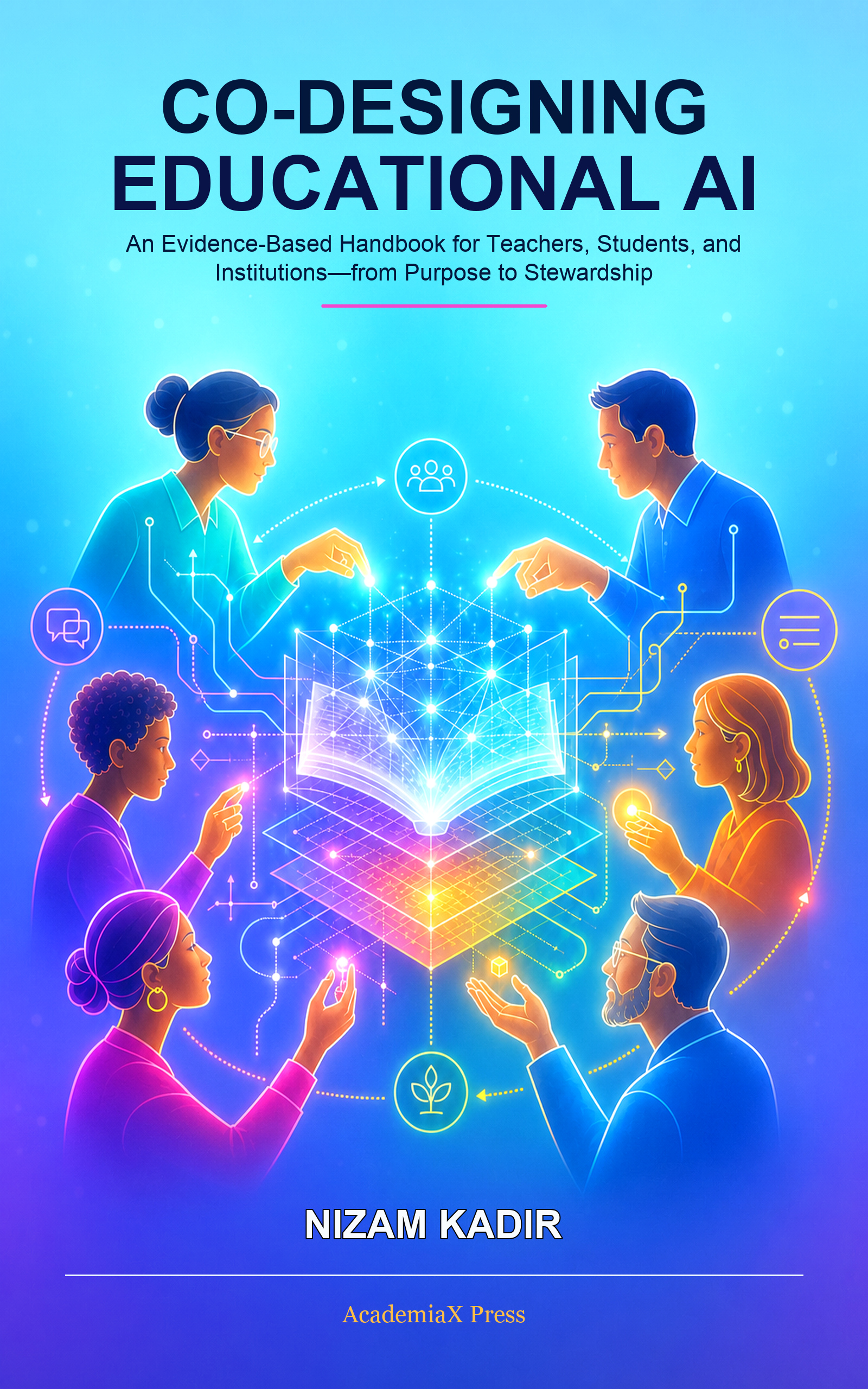
🤩 I am delighted to share that my new book, Co-Designing Educational AI: An Evidence-Based Handbook for Teachers, Students, and Institutions—from Purpose to Stewardship, is now available on Amazon worldwide. Published by AcademiaX Press, it is a practical and scholarly guide for anyone who wants to build educational AI with the people whose learning, work, data, rights, and institutions it will affect.
The book begins from one conviction: educational AI deserves a place in education only when the people affected by it can meaningfully shape its purposes, design, evidence, and governance. Teachers and students should not encounter an AI system only after its most consequential decisions have already been made. School leaders, administrators, learning designers, families, accessibility specialists, policy teams, and technical developers also hold knowledge that cannot be recovered from a dataset or inferred from a model.
This book is a companion and sequel to Machine Pedagogical Intelligence. That earlier book asked what cognitive and computational architectures an AI system needs in order to teach. Co-Designing Educational AI asks the equally important institutional question: how should such systems be conceived, built, evaluated, governed, and retired with educational communities rather than merely delivered to them?
Why co-design matters
Too many educational technologies are still organised around technical possibility rather than educational purpose. A team begins with a model or product idea, optimises it for accuracy or engagement, and asks teachers and learners for feedback only near the end. By then, the important choices—what problem counts, whose outcomes matter, what data will be collected, where human judgment remains essential, and what happens when the system causes harm—have already hardened into the design.
Meaningful co-design changes the order of work. It makes stakeholder knowledge part of the system specification. It treats participation as a distribution of decision rights, not simply a workshop technique. And it carries shared responsibility beyond prototyping into evidence, implementation, monitoring, contestation, adaptation, suspension, and retirement.
What the handbook offers
The handbook synthesises evidence from participatory design, artificial intelligence in education, learning sciences, human–computer interaction, responsible AI, implementation research, organisational change, and technology governance. It translates that evidence into concrete methods, decision tools, checklists, templates, examples, figures, and tables that teams can use throughout an educational AI project.
- distinguish consultation from meaningful stakeholder influence;
- decide whether AI is warranted before selecting a model or vendor;
- translate educational values into testable design requirements;
- co-design data, models, interfaces, workflows, and governance;
- evaluate learning, equity, accessibility, workload, safety, and trust; and
- create evidence and decision trails that remain auditable after release.
The PARTICIPATE-AI lifecycle
At the centre of the book is PARTICIPATE-AI, an eleven-stage lifecycle that moves from purpose to stewardship. It helps teams establish shared decision rights, frame the educational problem, understand the setting, determine whether AI is appropriate, translate stakeholder knowledge into requirements, allocate human–AI roles, prototype and evaluate the system, prepare the institution for implementation, and govern what happens after deployment.
The framework is deliberately a lifecycle rather than a one-off design event. Educational AI continues to change after release: models drift, school routines adapt, new risks emerge, and people discover effects that could not have been fully anticipated in a laboratory. Stewardship therefore includes continuous monitoring, routes for contesting decisions, and the institutional capacity to modify, suspend, or retire a system when its educational legitimacy no longer holds.
Who the book is for
I wrote this for teachers and students, but also for school and university leaders, administrators, researchers, learning designers, developers, product teams, policymakers, procurement teams, and anyone responsible for deciding how AI enters an educational setting. You do not need to be an AI engineer to use it. The central expertise is educational: knowing what learning requires, how institutions actually work, whose voices are missing, and where responsibility must remain human.
Educational AI should be built with people—not merely for them.
Thank you to the readers, educators, students, colleagues, and friends who have supported my writing and research. I hope this handbook helps teams build educational AI that is not only technically capable, but pedagogically grounded, institutionally workable, accountable, and worthy of trust.