
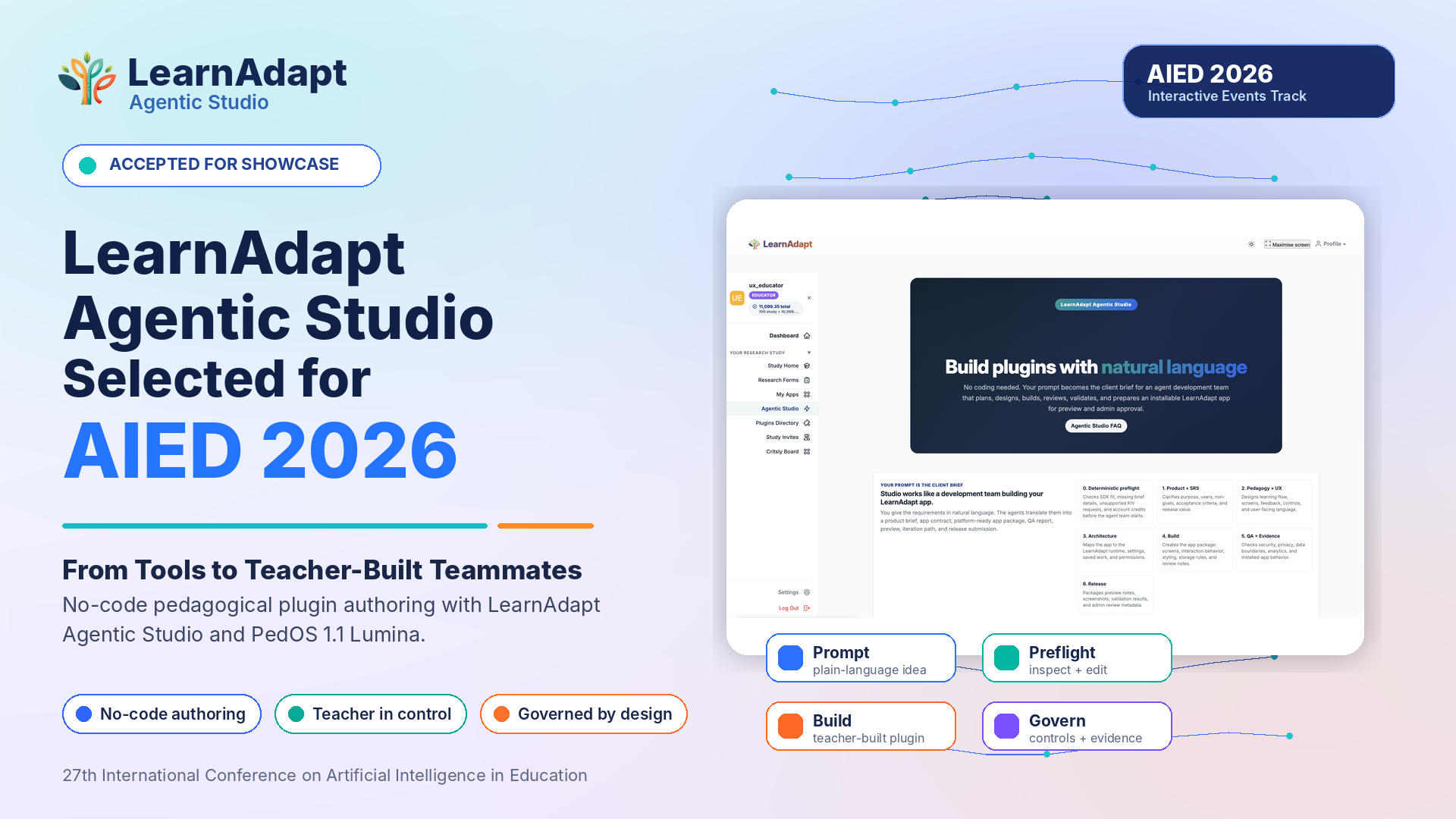
We are excited to share that LearnAdapt Agentic Studio has been accepted for the AIED 2026 Interactive Events Track and selected to be showcased at the 27th International Conference on Artificial Intelligence in Education.
Our accepted submission is:
“From Tools to Teacher-Built Teammates: No-Code Pedagogical Plugin Authoring with LearnAdapt Agentic Studio and PedOS 1.1 Lumina”
This is an important milestone for LearnAdapt, Agentic Studio, and the broader work we are doing around teacher-built educational AI.
At the heart of this work is a simple belief:
Teachers should not only use educational AI tools. They should be able to build, inspect, edit, govern, and adapt them.
From AI Tools to Teacher-Built Teammates
Much of the current conversation around AI in education focuses on tools that are given to teachers and students.
Some tools help generate content.
Some tools automate feedback.
Some tools support tutoring, planning, or assessment.
But for educational AI to become genuinely useful in real classrooms, teachers need more than ready-made tools. They need agency over how these tools are designed, what they do, what they collect, what they show to students, and how they align with pedagogical intent.
This is the shift LearnAdapt Agentic Studio is designed to support:
From tools teachers use, to AI teammates teachers build.
A teacher may begin with a real classroom problem: learners struggling with a concept, students needing more structured practice, teachers needing better visibility into student thinking, or a class requiring differentiated support. Instead of waiting for a generic tool to fit that need, the teacher can describe the problem in plain classroom language and begin shaping a pedagogical AI plugin around it.
What LearnAdapt Agentic Studio Does
LearnAdapt Agentic Studio is a no-code environment for pedagogical plugin authoring.
It allows educators to move from a teaching problem to a working AI-supported application through a structured workflow. Teachers describe what they need, review what the system understands, refine the proposed design, preview the resulting plugin, and decide what teacher controls and evidence flows should be included.
The aim is not simply to generate an app quickly.
The aim is to support a more thoughtful process of educational AI design, where teachers remain in control of the learning purpose, classroom fit, student experience, and governance conditions.
A teacher-built AI plugin might support activities such as:
- diagnosing student misconceptions,
- guiding reflection,
- scaffolding practice,
- supporting peer review,
- generating formative feedback,
- summarising learning evidence,
- or helping teachers identify where learners need support.
The important point is that these plugins are not imagined as generic AI tools. They are pedagogical teammates shaped around teacher intent.
Why No-Code Matters
Most teachers should not need to become software developers before they can shape educational technology.
No-code authoring matters because it lowers the barrier between a classroom problem and a usable educational AI application. Teachers can work in the language of teaching: learning goals, student needs, activities, misconceptions, feedback, evidence, and classroom constraints.
This matters especially in fast-moving educational contexts where the people closest to the learning problem are often not the people who can build the software.
LearnAdapt Agentic Studio asks:
What if the teacher who understands the learning problem could also shape the AI support?
What if educational AI design could begin with pedagogical intent, not technical syntax?
What if teachers could inspect and refine the system before deployment, rather than simply accepting what the AI produces?
The Role of PedOS 1.1 Lumina
The submission also features PedOS 1.1 Lumina, which supports the broader pedagogical operating system behind the work.
As educational AI becomes more agentic, governance becomes central. It is not enough for a system to produce outputs. Teachers need to know what is being inferred, what students can see, what data is captured, what can be edited, what must be approved, and what should never be delegated.
PedOS 1.1 Lumina helps frame this shift by foregrounding pedagogical control, evidence return, and governance.
In other words, the question is not only:
Can AI help build an educational application?
The deeper question is:
Can teachers govern how that AI application behaves in real learning contexts?
Designed Around Teacher Control
A key part of LearnAdapt Agentic Studio is the teacher-in-the-loop workflow.
Teachers should be able to inspect what the system understands before a plugin is generated. They should be able to edit the design if the system misunderstands the classroom problem. They should be able to preview how the plugin works. They should be able to decide what evidence returns to them. They should be able to define what students see, what remains private, and where human judgement is required.
This is why the work places emphasis on actions such as:
inspect, edit, approve, override, hide, export, and govern.
These are not peripheral features. They are essential conditions for responsible educational AI.
If AI is going to enter classrooms as a teammate, then teachers need meaningful control over that teammate.
Why This Matters for AI in Education
The AIED community is one of the most important spaces for asking how artificial intelligence can support learning in ways that are rigorous, ethical, and pedagogically meaningful.
Being selected for the Interactive Events Track is especially meaningful because LearnAdapt Agentic Studio is not only a concept. It is a working system designed to be demonstrated, explored, questioned, and improved through interaction with educators, researchers, and practitioners.
The Interactive Events format gives us the opportunity to show how a teacher can move from a classroom problem to a plugin idea, inspect the system’s proposed interpretation, refine the design, and discuss the governance questions that emerge along the way.
This is exactly the kind of conversation educational AI needs.
Not just “what can AI generate?”
But:
- What should teachers be able to control?
- What evidence should return to educators?
- What should remain visible or hidden from students?
- What should AI be allowed to decide?
- What must remain under human judgement?
- How do we design systems that teachers can trust, adapt, and critique?
Recognition from the AIED 2026 Review
We are grateful to the AIED 2026 Interactive Events Track committee and reviewers for recognising the value of this work.
The review highlighted that the proposed system addresses a timely and critical gap, aligns well with the conference theme, and thoughtfully incorporates governance considerations.
The review also pointed to areas we are continuing to improve, especially around making the teacher interaction workflow clearer and demonstrating how a generated plugin works in practice.
That feedback is valuable. It directly reflects the next step of this work: making the teacher journey through Agentic Studio more visible, more understandable, and easier to experience during the live showcase.
Looking Ahead
This milestone strengthens our commitment to building educational AI systems that are not only powerful, but also teacher-centred, inspectable, governable, and grounded in real classroom needs.
LearnAdapt Agentic Studio is part of a broader vision:
Teachers should be able to move from classroom problems to AI-supported pedagogical applications without needing to code.
They should be able to test and critique those applications.
They should be able to govern what the AI does.
They should receive useful evidence back.
And they should remain the pedagogical authority throughout the process.
We look forward to showcasing LearnAdapt Agentic Studio and PedOS 1.1 Lumina in person at AIED 2026, and to engaging with the wider community on what teacher-built AI should look like in practice.
Learn. Build. Govern. Together.
Paper links
This accepted AIED 2026 Interactive Events contribution documents LearnAdapt Agentic Studio and PedOS 1.1 Lumina as a no-code authoring and governed runtime workflow for educational-AI plugins.