
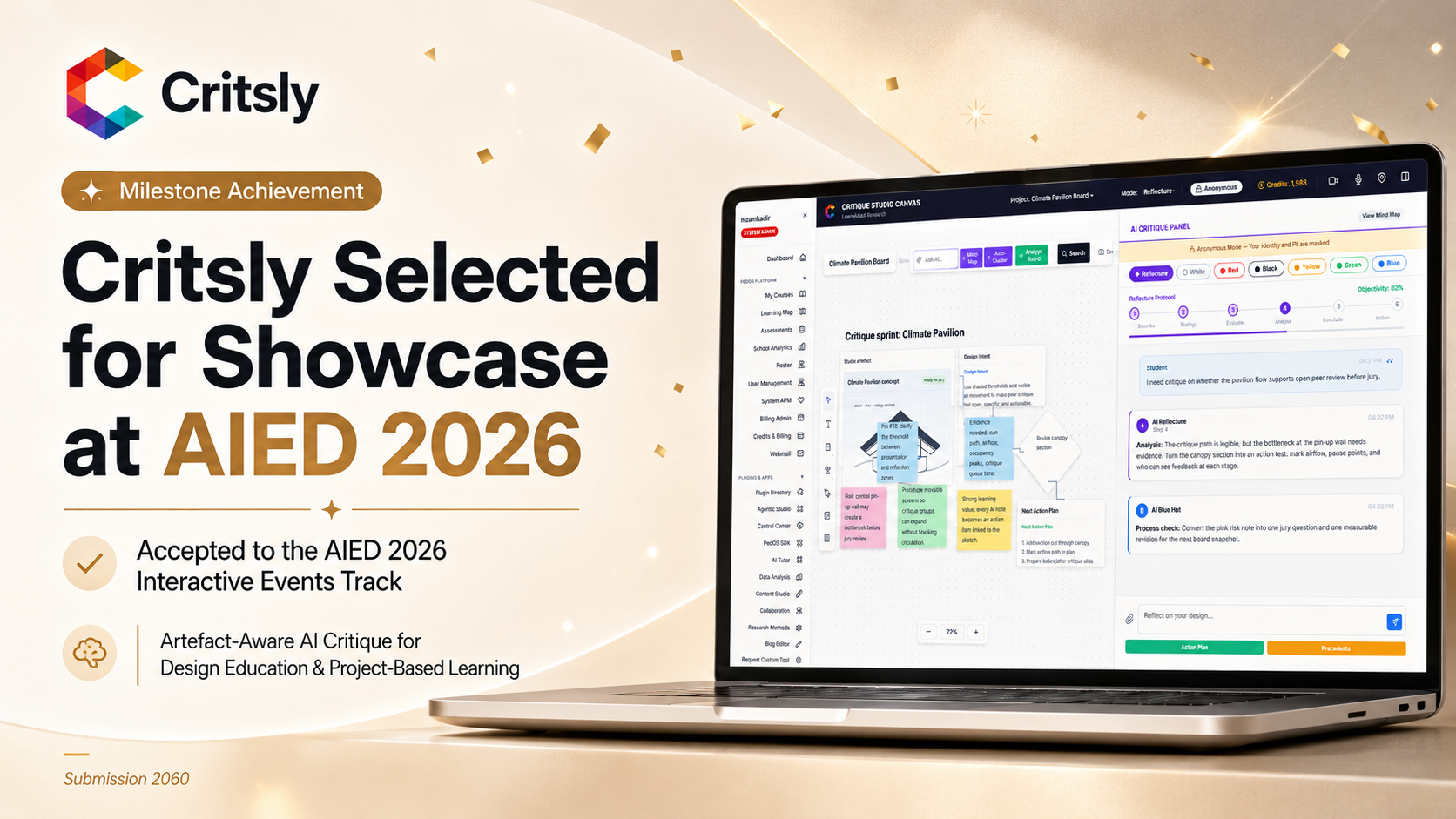
We are excited to share that Critsly has been accepted to the AIED 2026 Interactive Events Track and selected to be showcased at the 27th International Conference on Artificial Intelligence in Education.
Our submission, “Critsly: An Artefact-Aware AI Critique Teammate for Design Education and Project-Based Learning”, will be featured as part of the interactive programme, where we will demonstrate the working system live.
This is an important milestone for Critsly, and for the broader idea we are building around: making critique more structured, scalable, reflective, and pedagogically meaningful.
Why Critique Matters
Design education and project-based learning are built around critique.
A student brings an artefact into a studio, classroom, review session, or project space. The artefact may be a design board, a prototype, a visual concept, a model, a presentation, or an early-stage project output. Around that artefact, learning happens through feedback.
But in many learning environments, critique remains messy.
Feedback may be delivered verbally, written on sticky notes, scattered across screenshots, added as informal comments, or exchanged between peers in unstructured ways. Some comments are useful. Some are vague. Some are contradictory. Some are too harsh. Some disappear before the student has a chance to act on them.
The problem is not that feedback does not exist.
The problem is that feedback often fails to become learning.
The Problem Critsly Addresses
Critique is central to learning, but critique does not scale.
In a design studio or project-based course, one educator may be expected to provide meaningful, detailed, and actionable feedback to many students at once. Students need clarity on what to improve next. Educators need visibility into where students are struggling. Institutions need better evidence of learning, reflection, and progress.
Current workarounds often involve stitching together tools such as whiteboards, shared documents, learning management systems, screenshots, and generic AI chat tools. These tools may each support part of the workflow, but they are not purpose-built for pedagogical critique.
Critsly was created to address this gap.
What Critsly Does
Critsly is an AI-powered critique studio canvas for design education and project-based learning.
It helps turn messy critique into structured, actionable, and measurable learning by bringing together:
- Artefact-aware AI that can reason around the design or project artefact
- Structured critique workflows aligned with pedagogical review practices
- Peer review support that helps make feedback clearer and more constructive
- Action planning so students leave with concrete next steps
- Educator analytics that help instructors understand critique patterns, student needs, and learning progress
The aim is not to replace educators.
The aim is to support educators, students, and peers in making critique more useful, more reflective, and more actionable.
Why AIED 2026 Matters
The AIED community brings together researchers, educators, designers, technologists, and practitioners working at the intersection of artificial intelligence and learning. Being selected for the Interactive Events Track is especially meaningful because Critsly is not only a research idea; it is a working system intended to be explored, tested, and discussed in practice.
The Interactive Events format gives participants the opportunity to engage directly with the system, ask questions, explore the interface, and discuss how artefact-aware AI can support critique-driven learning environments.
We are grateful to the AIED 2026 Interactive Events Track committee and reviewers for recognising the value of this work. The review highlighted Critsly’s practical contribution to design education, the novelty of grounding critique in persistent structured board states, and the theoretical grounding behind the design choices.
Looking Ahead
This milestone strengthens our commitment to building Critsly as critique infrastructure for education.
We believe that critique should not disappear after a studio session, project review, or peer discussion. Every feedback pin, comment, reflection, and revision can become part of a richer learning record.
Critsly is being built to help students move from feedback to action, help educators scale meaningful critique, and help institutions better understand learning in project-based environments.
We look forward to showcasing Critsly at AIED 2026 and engaging with the wider community on how AI can support critique, reflection, feedback, and learning.
Got crits? We do.
Paper links
This accepted AIED 2026 Interactive Events contribution presents Critsly as an artefact-aware AI critique workspace connecting a visual board, guided reflection, multi-perspective critique, action planning and educator evidence traces.