
Conversations about educational technology have shifted dramatically from generative AI chatbots to autonomous “agentic” systems. Agentic AI refers to AI agents that can set goals, plan and carry out multi‑step workflows without waiting for detailed instructions. Imagine a virtual tutor that identifies when a student is falling behind, adapts the lesson plan accordingly and proactively reaches out to re‑engage them — that’s agentic AI in action.
A recent systematic review synthesising 28 empirical studies published between 2015 and 2025 found that teachers are already experimenting with AI in lesson planning, prompt generation and creative ideation. Traditional AI tools are being used to design analytics and feedback systems, but in most cases AI acts as an assistant rather than a true co‑designer. The researchers identified four pedagogical affordances driving tool selection: efficiency, responsiveness, creativity and equity. This underscores the evolving role of teachers as instructional designers in AI‑mediated environments and the need for equitable, context‑sensitive models of teacher‑AI collaboration.
At the same time, industry forecasts suggest that adoption of agentic AI is accelerating. An ed‑tech consultancy notes that 40 % of enterprise applications will embed specialised AI agents by the end of 2026, and that 86 % of organisations plan to increase their investment in such technologies. These agents are expected to power personalised learning paths, autonomous tutoring, student retention interventions, instructor co‑pilots and administrative automation. Broader technology analysts predict that less than 1 % of enterprise software included agentic AI in 2024, but this will surge to 33 % by 2028, with the global market approaching US$200 billion by 2034.
This confluence of research and market momentum presents an exciting opportunity for educators. However, it also raises important questions: How do we ensure that agentic AI enhances rather than undermines teacher autonomy? How do we embed values such as equity and inclusivity into autonomous systems? The answer lies in co‑design.
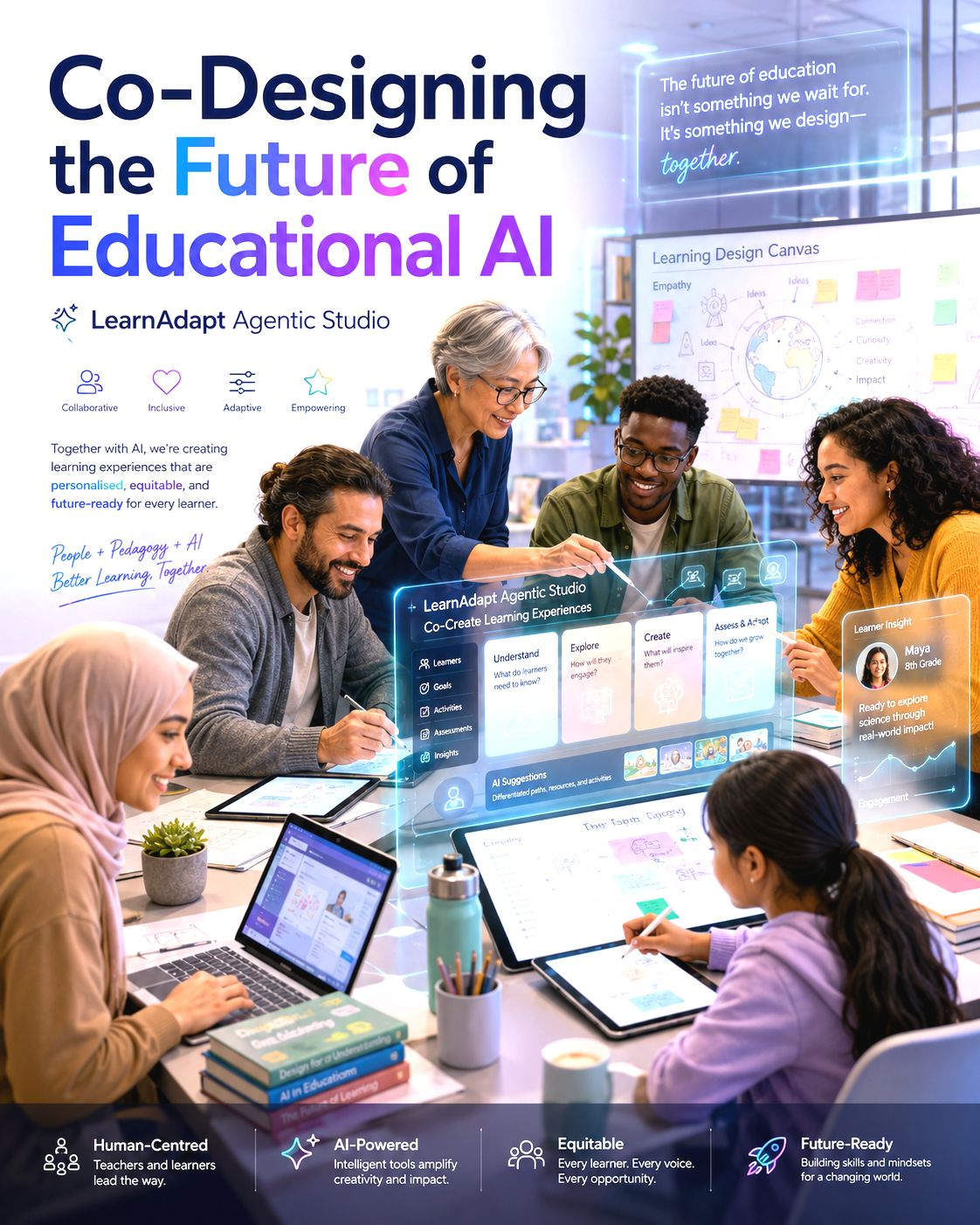
LearnAdapt Agentic Studio was built on the belief that teachers should be co‑architects of the AI tools they use. By bringing educators and technologists together, we can design agentic systems that support diverse learners, respect professional judgment and amplify creativity. Teachers can experiment with prototypes, provide feedback on AI behaviour and help fine‑tune the balance between automation and human decision‑making.
As we look to the future, I’m inspired by the potential of agentic AI to create more personalised, responsive and equitable learning experiences. But I’m equally aware that this potential will only be realised if we work collaboratively. I invite teachers, researchers and ed‑tech enthusiasts to join me at LearnAdapt Agentic Studio to explore, prototype and co‑design the next generation of educational AI. Together, we can ensure that agentic AI serves the needs of learners and educators alike.