
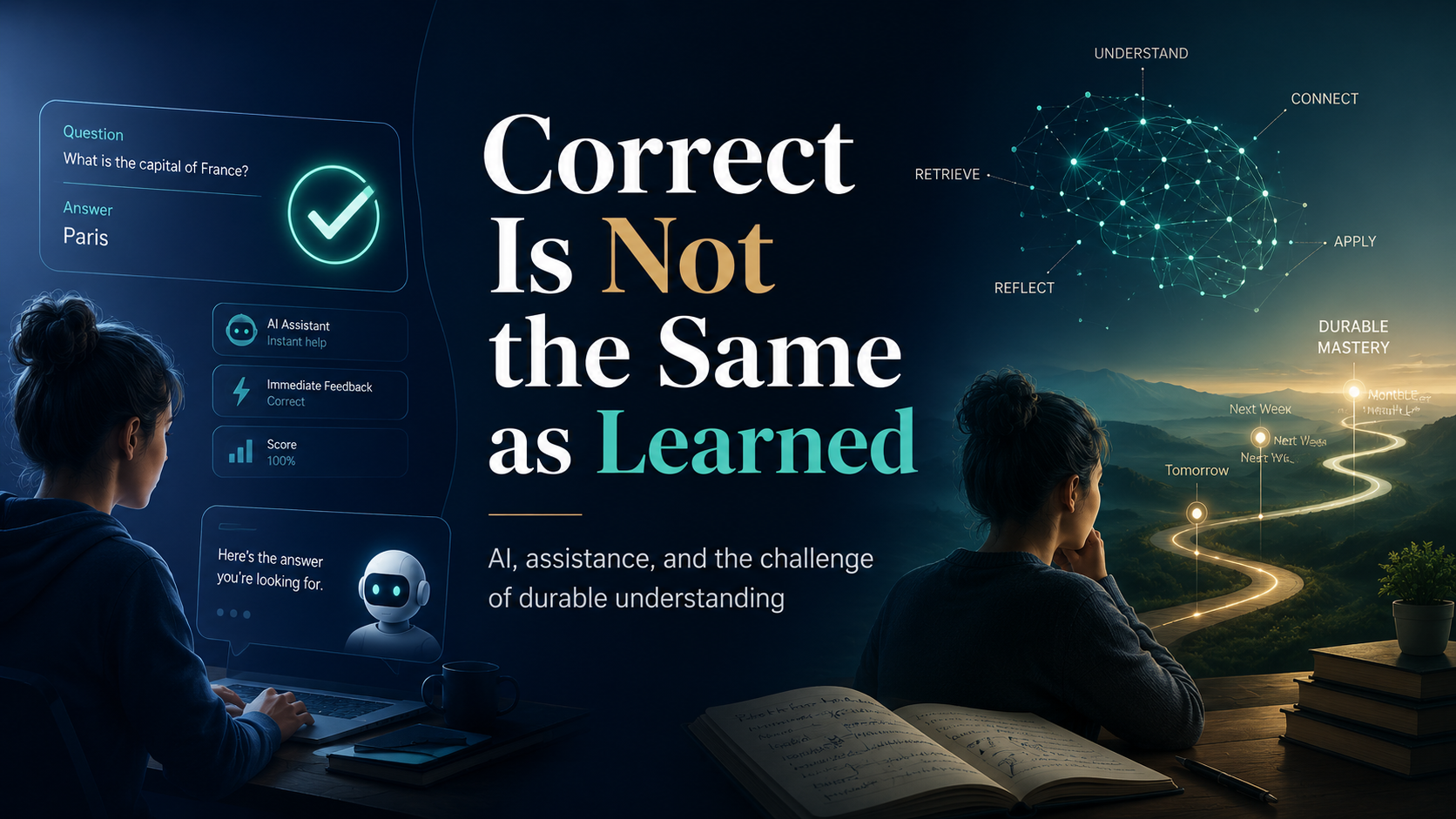
AI is quickly becoming part of how students learn.
It can explain a concept, rephrase a question, provide hints, generate examples, and guide a learner towards an answer almost instantly. Used well, that is incredibly powerful. It can make support more accessible, personalised, and responsive.
But it also creates a new problem.
A student may arrive at the correct answer without necessarily building durable understanding. (https://lnkd.in/gbWWHjCt)
That distinction matters.
In many learning environments, we tend to treat correctness as a signal of mastery. If a student answers correctly, we assume they understood. If their accuracy improves, we assume learning has taken place.
But AI assistance makes that assumption less reliable.
A learner can now receive very fluent, very targeted support. The system may reduce friction so effectively that the student appears to perform better in the moment, even if they are doing less retrieval, less self-correction, and less productive struggle.
The result is a subtle measurement challenge: are we seeing learning, or are we seeing assisted performance?
This is not an argument against AI tutors. Quite the opposite. AI can be one of the most important tools in education if it is designed carefully. The issue is not whether students should receive help. The issue is whether the help strengthens their understanding or quietly replaces the cognitive work required to build it.
Good educational technology should not simply optimise for getting students to the next correct answer. It should help students develop mastery that lasts beyond the immediate task.
That means asking better questions.
Not only:
“Did the student get it right?”
But also:
“How did they get it right?”
“Was the help productive or excessive?”
“Can they still do it after a gap?”
“Did the support build confidence, or dependency?”
“Are we measuring durable learning, or just short-term success?”
This is especially important as AI systems become more embedded in tutoring, assessment, and personalised learning. A system that looks effective in the moment may still fail learners if it rewards immediate fluency over long-term retention.
The future of AI in education should not be about removing all difficulty. Some difficulty is useful. Retrieval, reflection, and error correction are part of how learning sticks.
The better goal is to design AI support that is adaptive, bounded, and accountable. Enough help to move the learner forward. Not so much help that the system does the learning for them.
For me, this is one of the most important questions in AI education:
How do we build systems that can tell the difference between the appearance of mastery and mastery that survives the next gap?
That distinction will matter for students, teachers, institutions, and anyone building responsible AI learning systems.
Correct is useful.
But durable understanding is the real goal.