
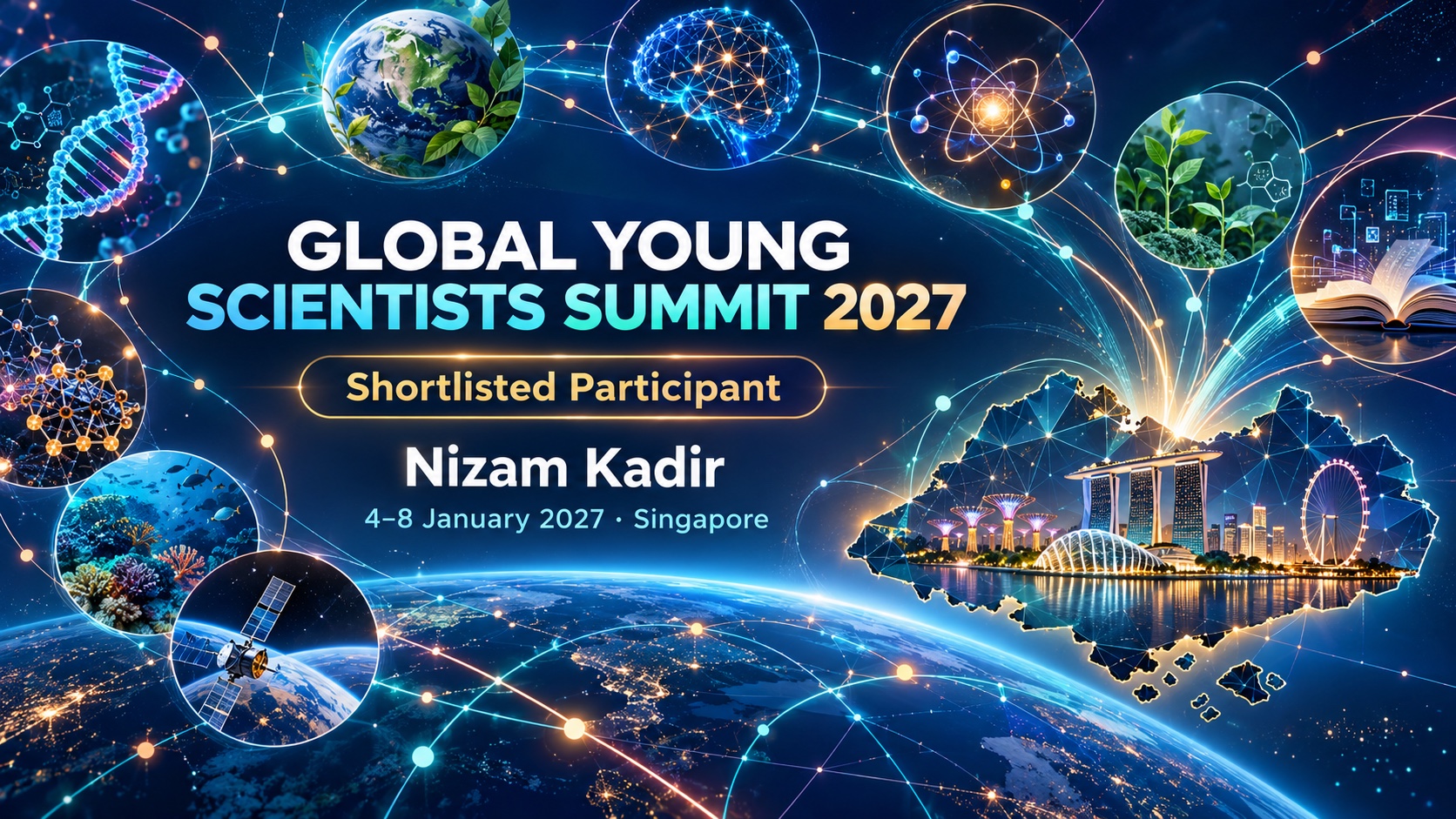
I am honoured to share that, following my nomination by Singapore University of Technology and Design (SUTD), I have been shortlisted by the GYSS 2027 Organising Committee to participate in the Global Young Scientists Summit.
I have completed the next-stage acceptance requirements and look forward to participating in Singapore from 4–8 January 2027.
Presenting ES-LLMs in the Technical Track
I will also present a poster in the GYSS Technical Track based on my peer-reviewed AIED 2026 long paper (full technical-track paper), From Untamed Black Box to Interpretable Pedagogical Orchestration: The Ensemble of Specialized LLMs Architecture for Adaptive Tutoring.
The work introduces ES-LLMs, an auditable architecture that separates pedagogical decision-making from language generation. A deterministic orchestrator coordinates specialised roles and explicit constraints, while a language model handles natural-language expression. The design asks a practical question: how can an AI tutor remain adaptive without hiding the teaching decisions it makes?

Read the published paper or the open arXiv preprint.
Organised by the National Research Foundation Singapore, GYSS brings young researchers into conversation with eminent scientists and peers from around the world. The summit spans fields including computing, engineering, medicine, mathematics, physics and chemistry, creating space for ideas to travel across disciplinary boundaries.
Why this opportunity matters to me
Some of the most important questions in educational AI cannot be answered within educational technology alone.
How should we decide whether an AI system is ready to be used with learners? How do we preserve human judgement as systems become more autonomous? What forms of evidence should guide development? And how can educators and students participate as genuine knowledge partners rather than merely becoming end users of systems designed elsewhere?
These are technical questions, but they are also questions of design, learning science, ethics, governance and institutional practice. A multidisciplinary gathering such as GYSS offers an opportunity to encounter very different ways of framing—and investigating—them.
My work focuses on co-designing educational AI with the people who will use and be affected by it. This includes exploring how educators can shape pedagogical agents and learning applications, how human feedback can remain meaningful throughout development, and how claims about educational value can be connected to appropriate evidence.
What I hope to learn
I will be bringing several questions with me:
- How do other scientific fields translate promising ideas into responsible real-world systems?
- What can educational AI learn from disciplines with mature approaches to safety, validation and accountability?
- How can adaptive systems remain legible and open to meaningful human intervention?
- How do we build international and interdisciplinary collaborations without losing sight of local educational contexts?
I do not expect a summit to provide simple answers. I value it as an opportunity to listen, challenge my current assumptions and develop better questions.
Looking forward to January
I am grateful to SUTD for the nomination and to the colleagues, collaborators, educators and students whose perspectives continue to shape my work. Co-design is never an individual undertaking, and neither is research.
If you will be attending GYSS 2027—or if your work intersects with educational AI, human–AI collaboration, co-design or responsible innovation—I would be glad to connect and exchange ideas.
Learn more at the official GYSS website.