
Over the past year, two questions have stayed at the centre of my
work.
What cognitive and computational architecture would an AI
need in order to teach—not merely answer?
And, just as importantly: who should have the power to shape,
evaluate and govern such a system?
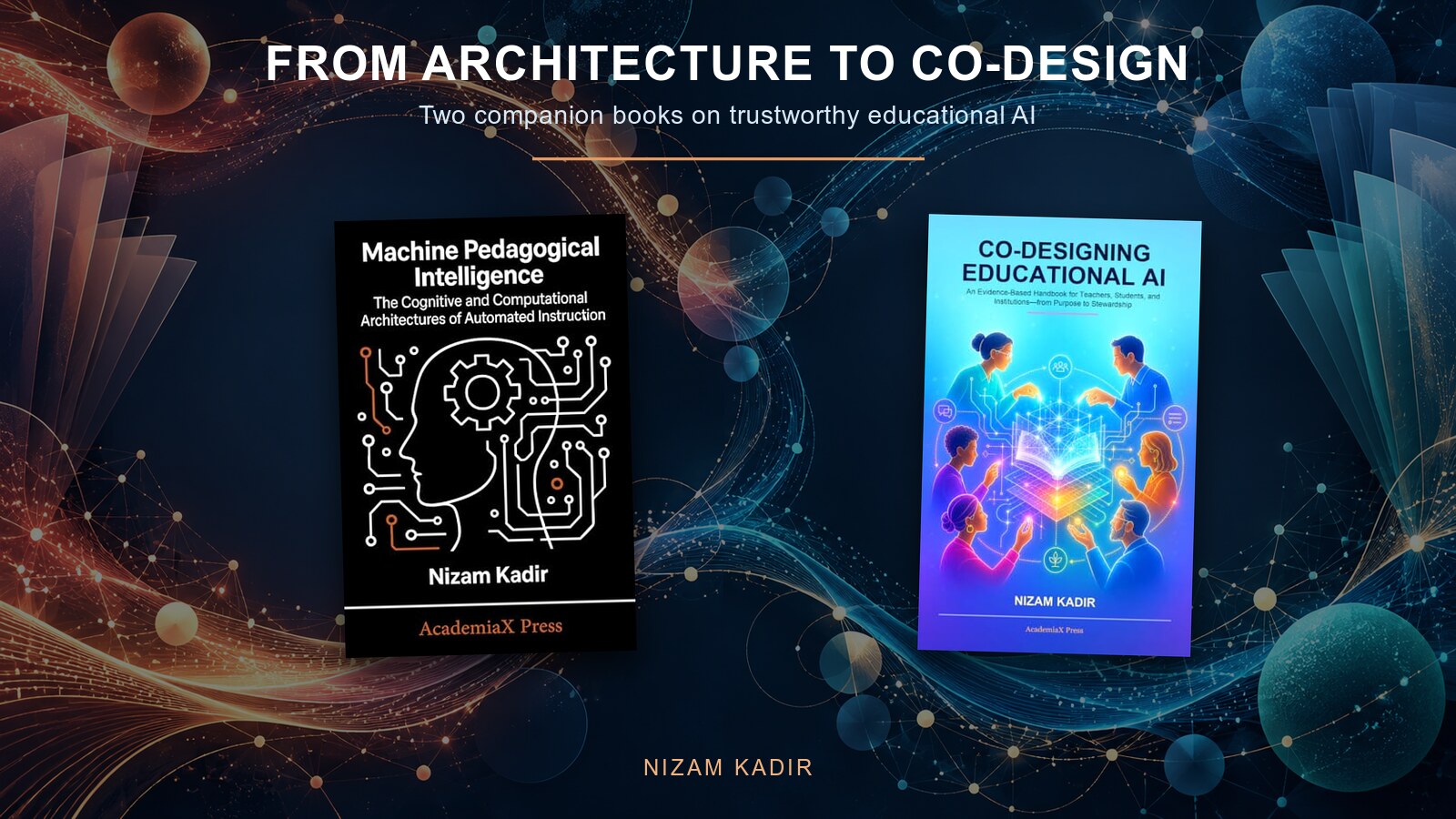
Those questions became two companion books. Machine Pedagogical
Intelligence examines the architecture of automated instruction.
Co-Designing Educational AI examines the human and
institutional arrangements that should guide educational AI from its
purpose and design through evidence, deployment, stewardship and, when
necessary, retirement.
I am returning to them here not simply as books to purchase, but as
two parts of a continuing research programme—one that has since moved
through peer-reviewed conference work, system development, public
discussion, and design recognition.
The
first question: what does an AI need in order to teach?

Machine Pedagogical Intelligence: The Cognitive and Computational
Architectures of Automated Instruction begins from a simple
distinction: generating a fluent response is not the same as making a
defensible teaching decision.
An educational system must do more than produce language. It must
represent what a learner may understand, select an appropriate
instructional action, decide when to scaffold and when to withhold help,
assess evidence of learning, adapt without becoming arbitrary, and make
its decisions open to inspection. That requires pedagogical
intelligence: specialised capabilities and control structures organised
around teaching and learning.
The book therefore asks architectural questions. Where should
pedagogical policy live? How should learner modelling inform
instructional decisions? Which responsibilities can be delegated to a
generative model, and which should remain explicit, testable and subject
to human judgement?
From a book
argument to an evaluated architecture
One strand of that argument was subsequently developed into the
Ensemble of Specialized LLMs architecture, or
ES-LLMs.
The paper, “From Untamed Black
Box to Interpretable Pedagogical Orchestration”, was published in
the proceedings of the 27th International Conference on
Artificial Intelligence in Education (AIED 2026) and appears in
the conference’s official
main-track programme. A free preprint is available on
arXiv.

ES-LLMs separates pedagogical decision-making from linguistic surface
generation. A deterministic orchestrator coordinates specialised
tutoring functions, applies explicit constraints, uses an interpretable
learner model and records traces that can be examined. The LLM is
responsible for expressing a selected action in natural language; it is
not left to silently invent the teaching policy on every turn.
The paper cites Machine Pedagogical Intelligence for this
control-and-auditability framing. In that precise sense, ES-LLMs
develops one strand of the book’s architectural argument into an
implemented and evaluated tutoring architecture.
The boundary matters. The ES-LLMs study provides evidence for the
tested architecture under its reported expert review, multi-model
evaluation and simulation conditions. It is not independent validation
of the book as a whole, nor is a conference publication evidence that
every educational setting will produce the same outcomes. The
contribution is a concrete, inspectable research step from conceptual
architecture toward testable implementation.
The wider conversation has been encouraging. The BOLD/EdTechnical
episode page, “Why
chatbots aren’t the future of educational AI”, included the ES-LLMs
paper among its research links. I was not a guest on the podcast, and
the listing should not be read as an independent review or endorsement
of the paper’s findings. It is meaningful because it places the problem
ES-LLMs addresses—moving beyond general-purpose chatbots—within a
broader discussion about fit-for-purpose educational AI.
The
companion question: who gets to shape educational AI?

Architecture alone is not enough. A technically elegant system can
still solve the wrong problem, distribute burdens unfairly, weaken
professional judgement, or enter an institution without legitimate
routes for contesting its decisions.
Co-Designing Educational AI: An Evidence-Based Handbook for
Teachers, Students, and Institutions—from Purpose to Stewardship
therefore asks a different but complementary question: how should
educational AI be conceived, built, evaluated, governed and retired
with the people whose learning, work, data, rights and
institutions it changes?
At its centre is PARTICIPATE-AI, an eleven-stage
lifecycle designed to move co-design beyond a one-off workshop. It
addresses shared decision rights, problem framing, the decision of
whether AI is warranted at all, translation of educational values into
system requirements, human–AI role allocation, evaluation,
implementation, monitoring, contestation and stewardship.
Read together, the books form a useful pair:
- Machine Pedagogical Intelligence asks what an AI needs in
order to make educationally defensible decisions. - Co-Designing Educational AI asks who should shape those
decisions, what evidence should count, where authority should remain
human, and how responsibility continues after release.
One is about the internal architecture of teaching systems. The other
is about the participatory and institutional architecture around
them.
The Seed Award and
the public conversation

I was honoured to receive the 2026
DBCS Seed Award from the Design Business Chamber Singapore
for work in education and technology that included Co-Designing
Educational AI. The award was especially meaningful because its
design-centred emphasis—creative impact, critical thinking, perseverance
and ethical decision-making—closely reflects the responsibilities at the
heart of co-design.
The recognition does not substitute for research evidence, nor does
it turn a design framework into a universal prescription. What it
recognised was a direction of work: combining technical development with
human judgement, participatory design and responsibility for
consequences.
That trajectory was subsequently profiled by Berita Minggu /
Berita Harian in “Penyelidik
raih anugerah bangun teknologi bantu pelajar guna AI”. The feature
explicitly connects Machine Pedagogical Intelligence, the
development of its ideas through my PhD research and the AIED 2026
paper, while also discussing Co-Designing Educational AI and
the Seed Award. SUTD published an English
summary of the feature.
I value that coverage because it captured the thread running through
the work: educational AI should help students understand, not merely
complete; adapt to learning needs without becoming opaque; and preserve
meaningful educator oversight.
Why read the books together?
These are not competing introductions to the same topic. They operate
at different levels.
Readers interested in intelligent tutoring systems, learner
modelling, instructional reasoning, scaffolding, assessment and
auditable orchestration may find Machine Pedagogical
Intelligence the natural starting point.
Teachers, students, leaders, researchers, designers, developers and
policy teams deciding how AI should enter a real educational setting may
begin with Co-Designing Educational AI.
Reading both creates a fuller picture. Trustworthy educational AI
depends on what happens inside the system and on the
social arrangements around it. It needs explicit
pedagogical architecture, but also legitimate participation, evidence,
governance and ongoing stewardship.
Read or preview
Both books are available on Amazon and Google Books. Prices and
formats vary by region.
Machine Pedagogical
Intelligence
Co-Designing Educational AI
The books are invitations as much as publications. I welcome
conversations with educators, students, researchers, institutions and
developers who want to test these ideas, challenge them, and co-design
educational AI whose intelligence is not only computationally
impressive, but pedagogically defensible and publicly accountable.