
When a correct answer is not yet evidence of learning
Educational AI can make success on the next task remarkably easy. But a learner who answers correctly now has not necessarily developed knowledge that will remain available next week.
That distinction sits at the centre of my new preprint, “Frac-BKT Under Mechanism Scrutiny: Response Assimilation and a Failed Fractional-Memory Test.” The work asks how a knowledge-tracing model should represent learning across time—and, just as importantly, how we should test whether the mechanism we have named actually does what we think it does.
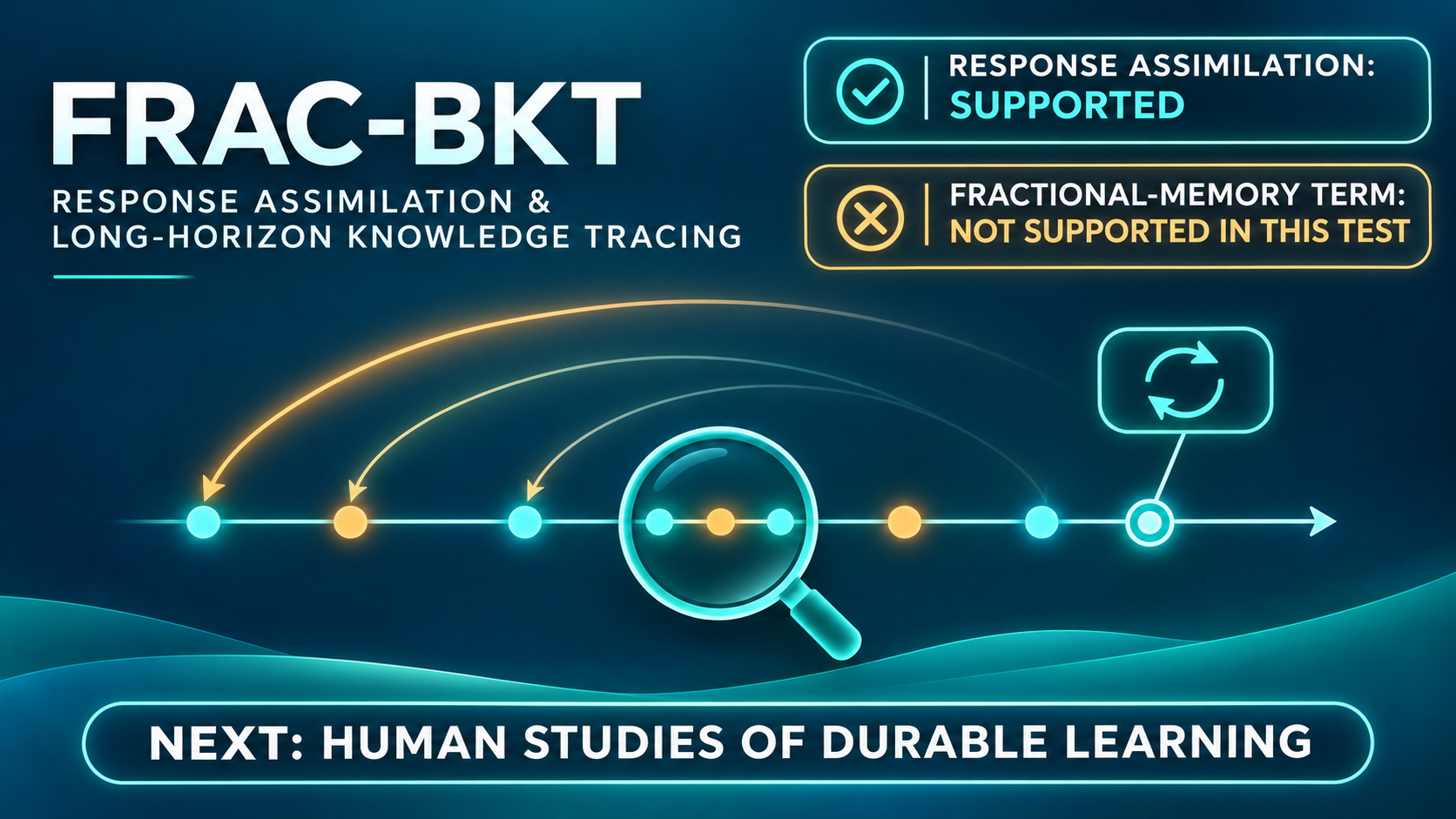
The most useful result is not a simple claim that “a new model wins.” It is a more honest and consequential finding: correctly assimilating each observed response improves the model substantially, while the fractional-history mechanism tested in this implementation does not survive matched controls.
That negative mechanism result is part of the contribution. Interpretable educational AI should not merely attach an intuitive label to a parameter. It should expose the mechanism, test it against matched alternatives and retain the explanation only if the evidence supports it.
What Frac-BKT tested
Bayesian Knowledge Tracing (BKT) represents a learner’s mastery of a skill as a latent state. Because its variables and transitions are compact, BKT is often easier to inspect than a large neural sequence model. The trade-off is that standard BKT is essentially one-step and Markovian: once the present state is known, a longer history is not represented directly.
Frac-BKT explored whether an explicit fractional-history term could provide an auditable form of longer memory. The response-aware model was evaluated across five seeds using 676,848 ASSISTments 2017 interactions from 1,694 learners and 19,249 learner–skill trajectories. Its chronological evaluation included responses after gaps of at least 30 minutes and at least 14 days.
Two findings matter.
First, temporal ordering and response assimilation are essential. The repaired model predicts the current response from the prior mastery state, then uses that response only to update the posterior state for future events. Relative to the earlier non-response implementation, this repair improved AUC by 0.0473 overall, 0.0316 after gaps of at least 30 minutes and 0.0277 after gaps of at least 14 days.
Second, the evaluated fractional-history term did not earn its interpretation. The full model did not outperform the matched alpha-equals-one control and was worse than the matched no-history control on both long-gap slices. Compact attention- and spacing-inspired references also remained stronger after long gaps.
The paper therefore does not claim state-of-the-art knowledge tracing, causal retention effects or proof of durable learning. Its long-gap outcomes are later logged responses, not randomized delayed post-tests. What it provides is a reproducible repair, a falsifiable audit and a clearer boundary between an appealing mechanism and an evidenced one.
How this extends the ES-LLMs research programme
This work connects directly to my AIED 2026 research on the Ensemble of Specialized LLMs architecture, or ES-LLMs.
ES-LLMs separates two responsibilities that are too often collapsed inside one generative model:
- Pedagogical policy decides what should happen next.
- An LLM expresses that selected action in natural language.
An interpretable BKT learner model helps the orchestrator decide whether to assess, scaffold, give feedback, encourage or progress. Explicit rules—such as requiring an attempt before a hint—can then constrain the system’s behaviour, while the decision trace remains inspectable.
Frac-BKT sharpens the learner-modelling side of that architecture. It shows that an interpretable state is not enough by itself: the update must be temporally valid, observed responses must be incorporated without leaking future information, and any proposed memory mechanism must survive controlled ablation.
In that sense, Frac-BKT makes the broader research programme better not because the fractional term has already solved durable learning, but because the audit tells us what to keep, what to reject and what evidence must come next. For educational AI, that form of disciplined falsification is a feature, not a failure.
From logged interactions to evidence about durable learning
The next step cannot be another accuracy table alone.
To study durable learning properly, we need human-subject research that can connect tutoring decisions to outcomes beyond the immediate interaction. The Frac-BKT paper identifies a responsible direction: randomized assistance policies, delayed post-tests, direct AI-interaction logs, preregistered construct validation, calibration and subgroup analysis.
This is where Archie Math can become a research platform as well as a learning application. Archie is designed around guided, Socratic mathematical support rather than immediate answer delivery. It offers a practical setting in which researchers could investigate questions such as:
- When should an AI tutor assess, scaffold or step back?
- How do different hint policies affect immediate success and later unaided performance?
- Can reassessment after meaningful time gaps distinguish productive support from shallow task completion?
- How should learner models communicate uncertainty without turning internal parameters into labels about students?
- Do effects differ across languages, curricula, age groups and educational contexts?
These are research questions, not product claims. Any study involving learners must proceed through appropriate institutional ethics review, local permissions, informed consent or assent, and responsible data governance.
An invitation to collaborate globally
I am looking for collaborators who would like to design and run human-subject studies with Archie Math across different countries and educational settings.
I would be glad to hear from researchers, schools, universities, mathematics educators and learning-science groups interested in:
- knowledge tracing and learner modelling;
- delayed learning and retention measures;
- adaptive scaffolding and help-seeking;
- randomized or quasi-experimental evaluations;
- multilingual and cross-cultural educational AI;
- human-centred, contestable and interpretable tutoring systems.
Potential collaborations could range from co-design and instrument development to preregistered multi-site studies. The aim is not to deploy an unvalidated learner-risk score. It is to build the evidence needed to understand when AI support helps learners think, practise and retain—and when it merely helps them finish.
If this aligns with your work, contact me at nizam_kadir@mymail.sutd.edu.sg or connect through Archie Math.
Research progresses when mechanisms are allowed to fail, explanations are revised and the next study is designed around what the evidence actually says. Frac-BKT is one step in that process—and an invitation to take the next step together.
Disclosure: Frac-BKT is an arXiv preprint. The reported long-gap predictions are retention-oriented stress tests, not direct causal measurements of retained learning.
Leave a Reply