
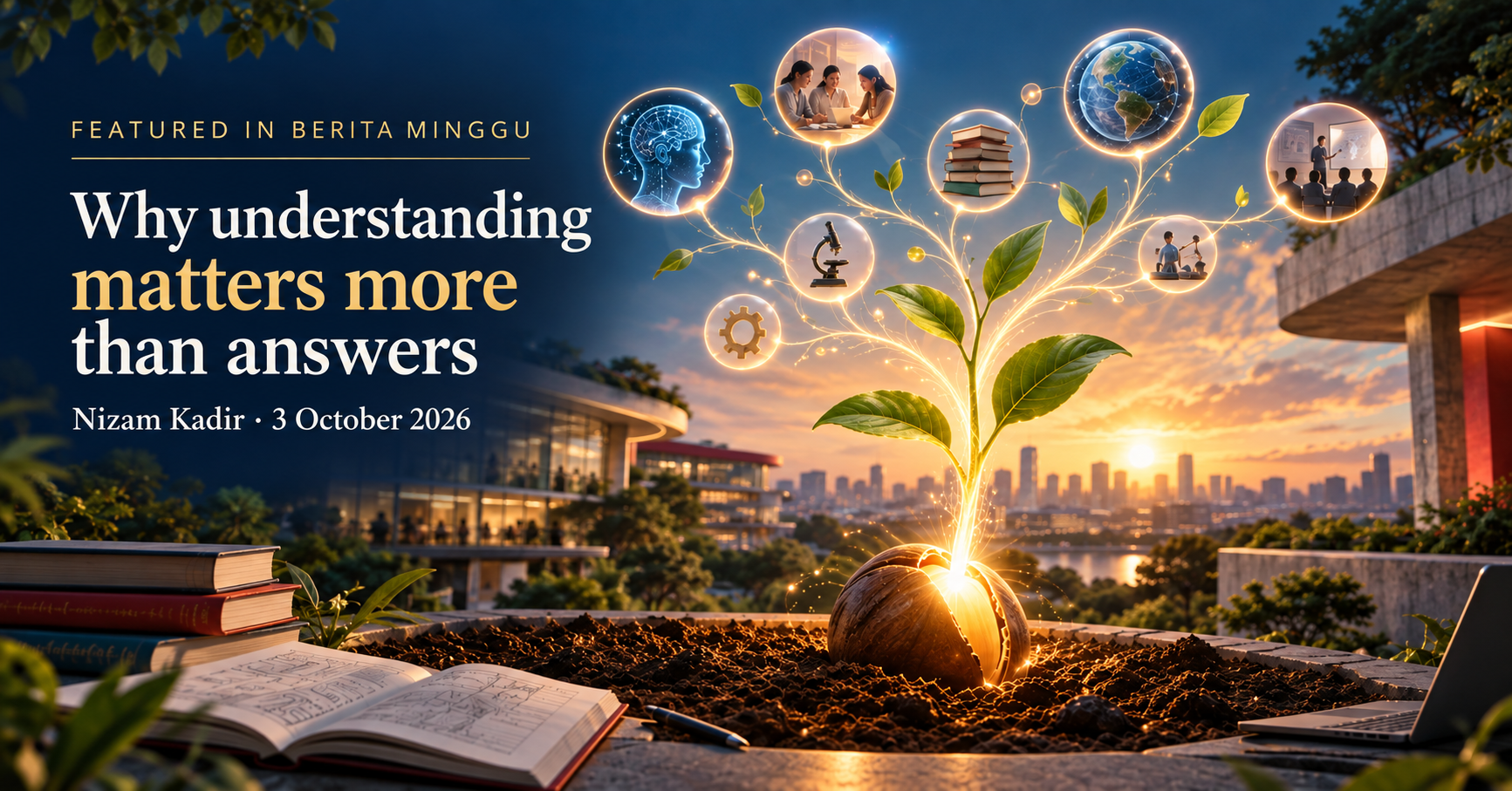
I am honoured to be featured in Berita Minggu / Berita Harian in an interview published on 3 October 2026.
Written by Ainin Alfiyani Jailani, with photographs by Nur Diyana Taha, the feature explores the journey from my years as an educator to my current doctoral research in machine pedagogical intelligence at the Singapore University of Technology and Design.
The interview was published in connection with the 2026 Seed Award, organised by the Design Business Chamber Singapore. I am grateful for the recognition and for the opportunity to discuss why the design of educational AI matters.
From correct answers to genuine understanding
The central question behind my work is not simply whether AI can produce a correct answer. It is whether an AI-supported learning experience helps a student understand, explain and transfer what they have learned.
Machine pedagogical intelligence examines how an AI system might make appropriate teaching decisions for different learning needs. Those decisions should also remain visible to educators so that they can review whether the system is behaving appropriately.
Research, books and applications
The feature discusses my books on machine pedagogical intelligence and co-design, as well as applications including Agentic Studio, Archie Math, CALLIOPE, Praxis and ClioMake.
These projects explore different forms of learning and educator support. Across them, however, one principle remains constant: educational AI should be guided by pedagogy, reviewed by people and developed with the communities expected to use it.
AI remains a tool
AI can generate material rapidly, but it cannot substitute for the human commitment to learn, practise and improve. Good educational technology should support that commitment rather than encourage dependence or bypass thinking.
I appreciate Berita Minggu and Berita Harian for sharing this work with the wider community. I also welcome conversations with educators, researchers and institutions interested in responsible co-design and evaluation.
Read the original Malay-language feature on BeritaHarian.sg.
This post is an English summary and personal reflection, not a reproduction of the full article.
Leave a Reply