
The era of the “monolithic” AI tutor in education is failing.
For a while, the industry dream was simple: deploy a single Large Language Model to act as a teacher, an ethical governor, and an evaluator all at once. But as we’ve seen these models deployed in real-world scenarios, a hard truth has emerged—relying on a single generalized AI to juggle all these complex pedagogical responsibilities simply doesn’t scale safely in real classrooms.
Over the last few months, my research—which I’m incredibly proud to share has been accepted to AIED 2026!—has focused on fundamentally breaking this paradigm. The solution lies in ES-LLMs (Ensembles of Specialized LLMs).
The ES-LLM Paradigm Shift
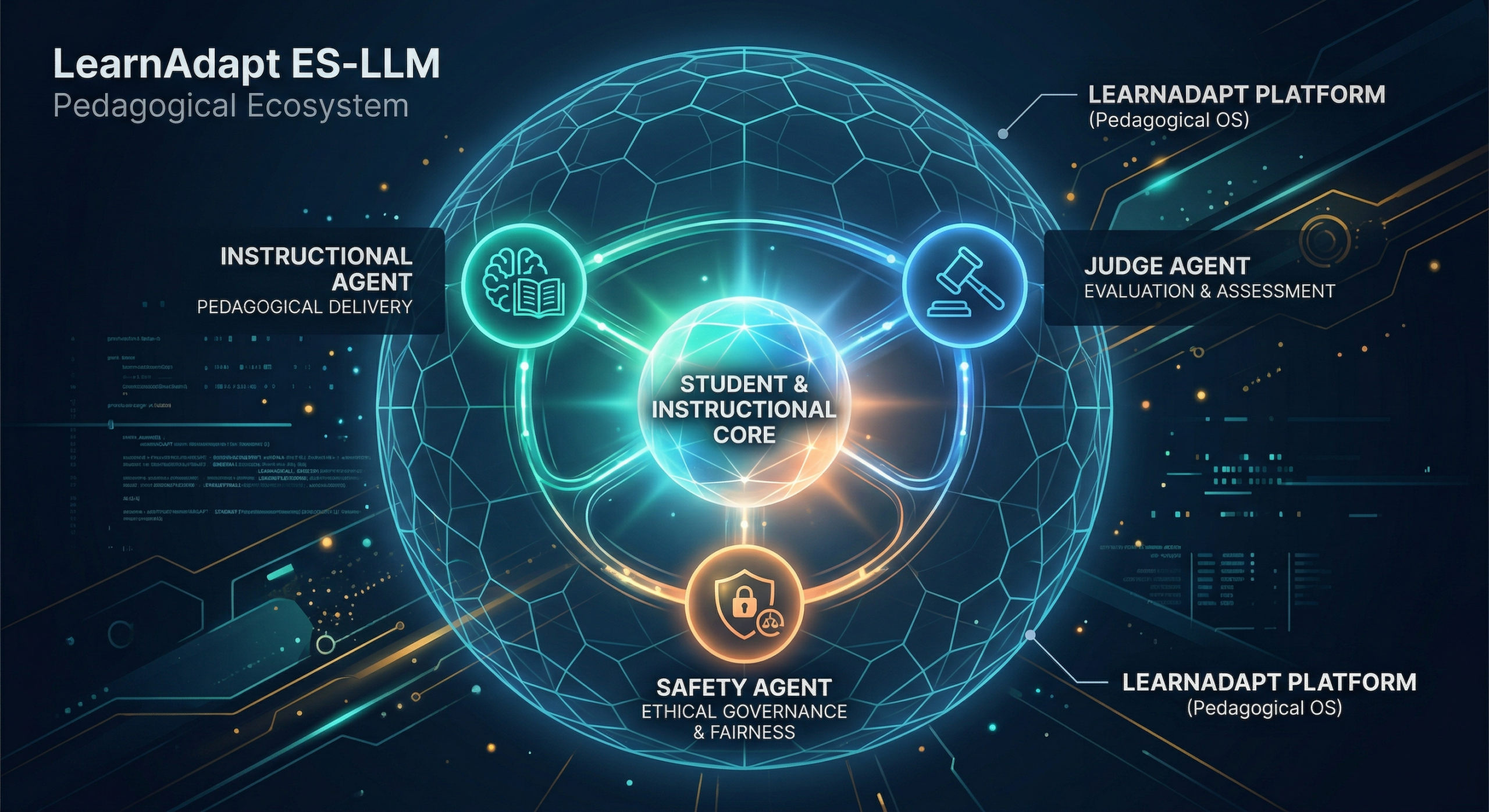
Instead of relying on one generalized AI, true pedagogical intelligence emerges when we orchestrate multiple specialized agents working in harmony. Imagine a system where:
- A primary instructional model guides the student.
- An evaluative “judge” model collaborates in real-time to assess understanding.
- An adversarial safety model continuously monitors the interaction to ensure strict demographic fairness.
The ES-LLM framework yields unparalleled instructional accuracy and safety. However, this breakthrough introduced a massive new bottleneck: where do we safely govern and test ensembles of this complexity? Running them in isolated Python scripts cannot scale to institutional levels.
That is exactly why I am thrilled to officially announce the evolution of the LearnAdapt Platform (LearnAdaptResearch.org). 🚀
Introducing the Definitive Ecosystem for Machine Pedagogical Intelligence
We are shifting LearnAdapt from a standalone research sandbox into a comprehensive ecosystem. If ES-LLMs are the specialized cognitive engines, LearnAdapt is the pedagogical operating system they run on.
We’ve built the missing layers of institutional governance required for the next wave of AI in Education (AIED). Here is how LearnAdapt bridges the gap between research and real-world deployment:
- 🔬 Governed Experimentation: We’ve wrapped multi-LLM ensembles in controlled execution environments. This allows us to capture critical micro-telemetry and interaction data without ever disrupting student workflows.
- ⚖️ Ethical Auditing: Before any system touches a classroom, we stress-test these ensembles against demographic edge-cases via the CABLES protocol. This guarantees algorithmic fairness before deployment, not after.
- 🧠 Seamless Integration: LearnAdapt allows educators and researchers to inject custom curriculum vectors into live RAG (Retrieval-Augmented Generation) simulations directly from a secure Data Sandbox.
Moving Beyond “AI Tools”
The conversation in EdTech needs to evolve. We are moving beyond simply building disconnected “AI tools.” The real challenge now is constructing the safe, observable, and governed ecosystems where complex machine intelligence can actually teach effectively and equitably.
I’ll be sharing more deep dives into the LearnAdapt architecture and the intricacies of our ES-LLM orchestrator logic soon. Stay tuned!
#AIinEducation #EdTech #MachineLearning #AIED2026 #LearnAdapt #GenerativeAI #Pedagogy #ResponsibleAI