
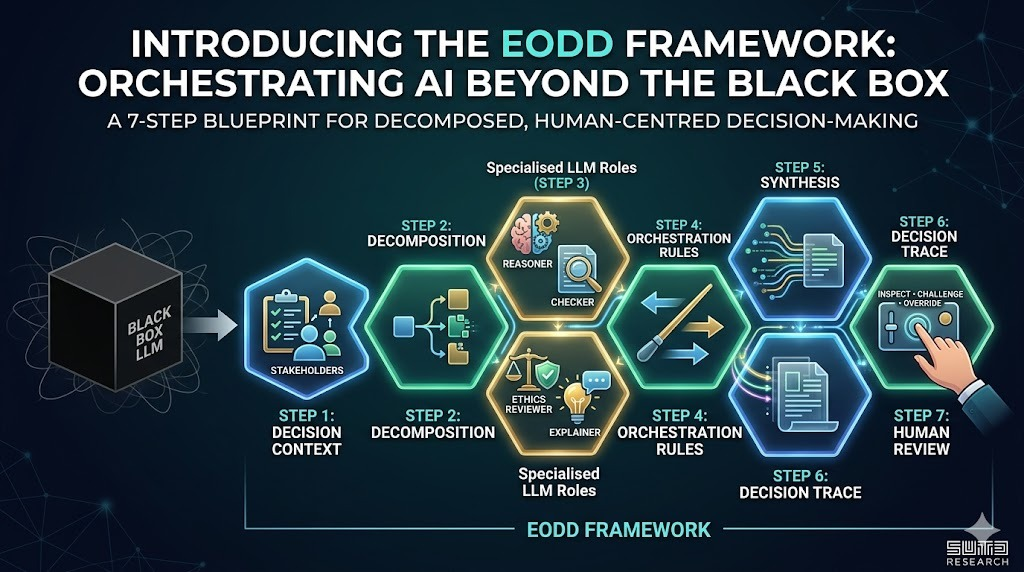
We have reached a plateau with “Black Box” Large Language Models. While their conversational fluency is undeniable, deploying a single, monolithic AI to handle complex, high-stakes decisions is fundamentally flawed. When we ask one model to simultaneously generate ideas, check facts, enforce ethics, and format the output, we lose architectural control.
In my book, Machine Pedagogical Intelligence, I explored how this lack of control leads to systemic failures, such as the Mastery Gain Paradox in education. But the solution isn’t just a better prompt—it is a better architecture.
To build AI systems that are safe, interpretable, and rigorously evaluable, we must move from untamed generation to structured orchestration. Enter the EODD (Explicit Orchestrated Decision Design) Framework.
What is the EODD Framework?
The EODD Framework is a domain-agnostic, human-centred blueprint designed to replace monolithic AI workflows with auditable, multi-agent orchestration.
Instead of treating an LLM as a magical oracle, EODD treats AI as a structured team. It forces us to decouple the logic, distribute the cognitive load across specialized roles, and generate a transparent trail of rationale before a human ever makes the final call.
Here is the anatomy of the EODD approach.

Phase 1: Framing the Logic (Steps 1 & 2)
You cannot orchestrate what you haven’t defined. The first phase of EODD moves away from generic prompt engineering and into rigorous task architecture.
1. Decision Context Before any AI is invoked, the environment must be locked down. What is the specific task definition? Who are the stakeholders impacted by this decision? What are the hard constraints (e.g., budget, safety protocols, pedagogical rules) that cannot be violated?
2. Decision Decomposition This is where monolithic AI is dismantled. We break the complex decision into localized cognitive tasks. Instead of asking for a single answer, we separate the workflow into distinct lanes: Reasoning, Checking, Ethics, and Explanation.
Phase 2: The Multi-Agent Engine (Steps 3 & 4)
Once the decision is decomposed, we assign these localized tasks to specialized, narrow-focus models.
3. Specialised LLM Roles We deploy a team of distinct agents. The Reasoner explores solutions, while the Checker actively attempts to find flaws in the Reasoner’s logic. Simultaneously, an Ethics Reviewer evaluates the proposed paths against the constraints defined in Step 1, while an Explainer translates the technical logic into plain language.
4. Orchestration Rules Specialized roles mean nothing without a conductor. The orchestrator governs the sequencing of these agents. It enforces constraints (e.g., “The Reasoner cannot output a decision without approval from the Ethics Reviewer”) and establishes clear Human Triggers—predetermined thresholds where the AI must pause and ask for human intervention.
Phase 3: Transparency and Oversight (Steps 5, 6, & 7)
The final phase ensures that the AI’s internal logic is synthesized, logged, and ultimately controlled by a human expert.
5. Decision Synthesis The orchestrator integrates the disparate outputs from the specialized roles and formulates a cohesive Decision Proposal.
6. Decision Trace This is perhaps the most critical component of the EODD framework. The system generates a complete Rationale Log. It documents exact role contributions and explicitly lists the assumptions the models made. This transforms the AI from an unreadable Black Box into an auditable Glass Box.
7. Human Review The loop closes with a human expert. Because of the Decision Trace, the human does not just see the final answer; they see the work. This grants the human operator the true ability to seamlessly Inspect, Challenge, and Override Authority.
The Future is Orchestrated
The era of relying on stochastic, probabilistic prompting for high-stakes workflows is ending. Whether you are building adaptive tutoring systems, financial analysis tools, or clinical diagnostic aids, the requirements remain the same: the system must be iteratively refinable and rigorously evaluable.
The EODD framework proves that generative fluency and architectural control are not competing goals. By structurally decoupling decisions, we can finally build AI that we can trust.