
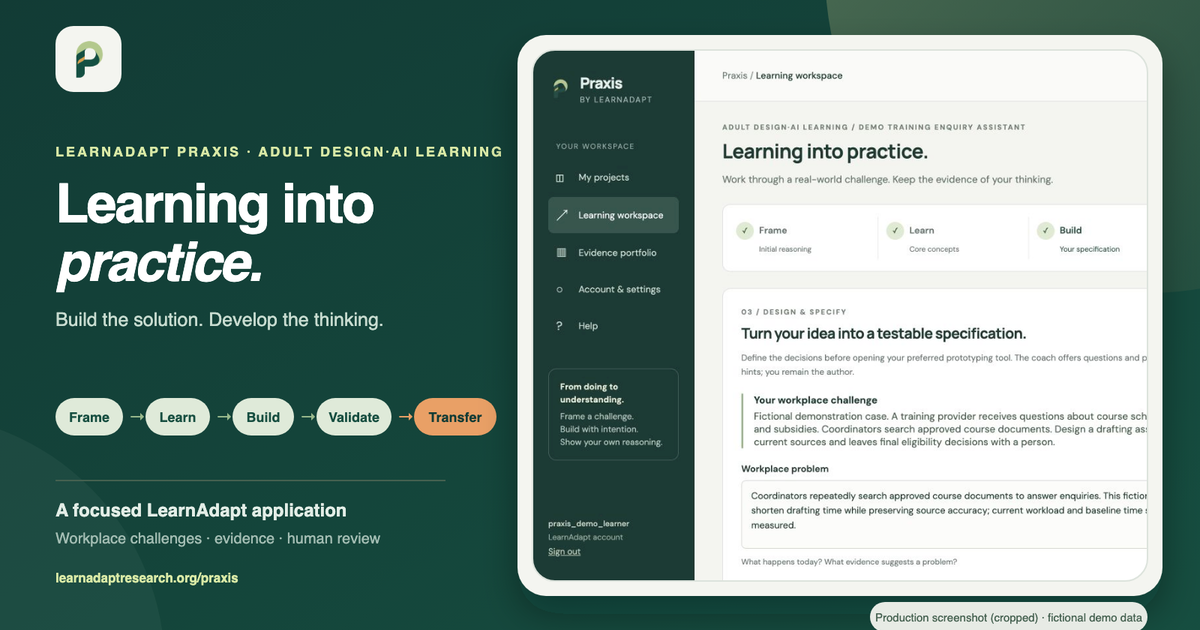
I am introducing LearnAdapt Praxis, a new application in the LearnAdapt ecosystem for adults developing Design·AI capability through workplace challenges.
Praxis is organised around five stages: Frame, Learn, Build, Validate, and Transfer. Together, they support a journey from understanding a real workplace problem to developing an AI-supported service, testing its behaviour, and applying the learning to a new challenge.
Why build Praxis?
A finished prototype can hide much of the learning that produced it. It may not show how someone initially framed the challenge, which assumptions changed, how assistance was used, why the specification evolved, what testing revealed, or how the learner responded when faced with something new.
Praxis keeps that journey available for review. The learner’s initial response, evolving specifications, use of in-app coaching, validation observations, transfer response, and facilitator feedback can be considered together.
This gives learners a clearer record of their own development. It also gives facilitators a stronger basis for asking questions, discussing decisions, providing feedback, and deciding what support should come next. Praxis is designed to support those human conversations, not replace them with an automated verdict.
Frame, Learn, Build, Validate, Transfer
In Frame, the learner defines the workplace challenge, the people affected, and their starting assumptions.
In Learn, the learner develops the concepts needed to approach the challenge thoughtfully, with in-app support available where appropriate.
In Build, the learner turns the idea into an AI-supported service specification and revises it as their understanding develops.
In Validate, the learner tests the proposed service against realistic scenarios, records observations, and identifies what needs to change.
In Transfer, the learner applies the ideas to a new challenge. Praxis can remove access to its own coaching, earlier project work, and export tools during this stage, creating a more clearly bounded in-application task. That boundary has limits: it cannot prevent outside assistance and does not prove unaided performance.
A focused application in a wider ecosystem
LearnAdapt is developing as an ecosystem of purpose-built educational applications rather than one general-purpose chatbot.
Praxis uses shared LearnAdapt account and application-runtime foundations while retaining its own workflow and services. It is informed by the wider Agentic Studio and PedOS programme. Agentic Studio represents the pathway for creating and reviewing focused applications, while PedOS represents the broader direction for a governed application environment. LearnAdapt Connect provides a pathway for working with existing institutional learning systems.
This is intentionally bounded language. Praxis should not be described as completely integrated with every LearnAdapt product, and further connections should be introduced only where they serve a genuine educational purpose.
Co-designing the next stage
Praxis is an early application, and the people who may learn with it or facilitate that learning should help shape what comes next.
I welcome conversations with adult learners, educators, workplace-learning teams, learning designers, HCI and learning-science researchers, and institutions interested in:
- co-designing the five-stage learning journey;
- examining facilitator workflows and evidence needs;
- evaluating accessibility and usability;
- exploring carefully bounded workplace-learning applications; and
- studying supported learning and transfer without overstating what in-app controls can demonstrate.
If that connects with your work, I would be glad to explore a collaboration.
Leave a Reply