
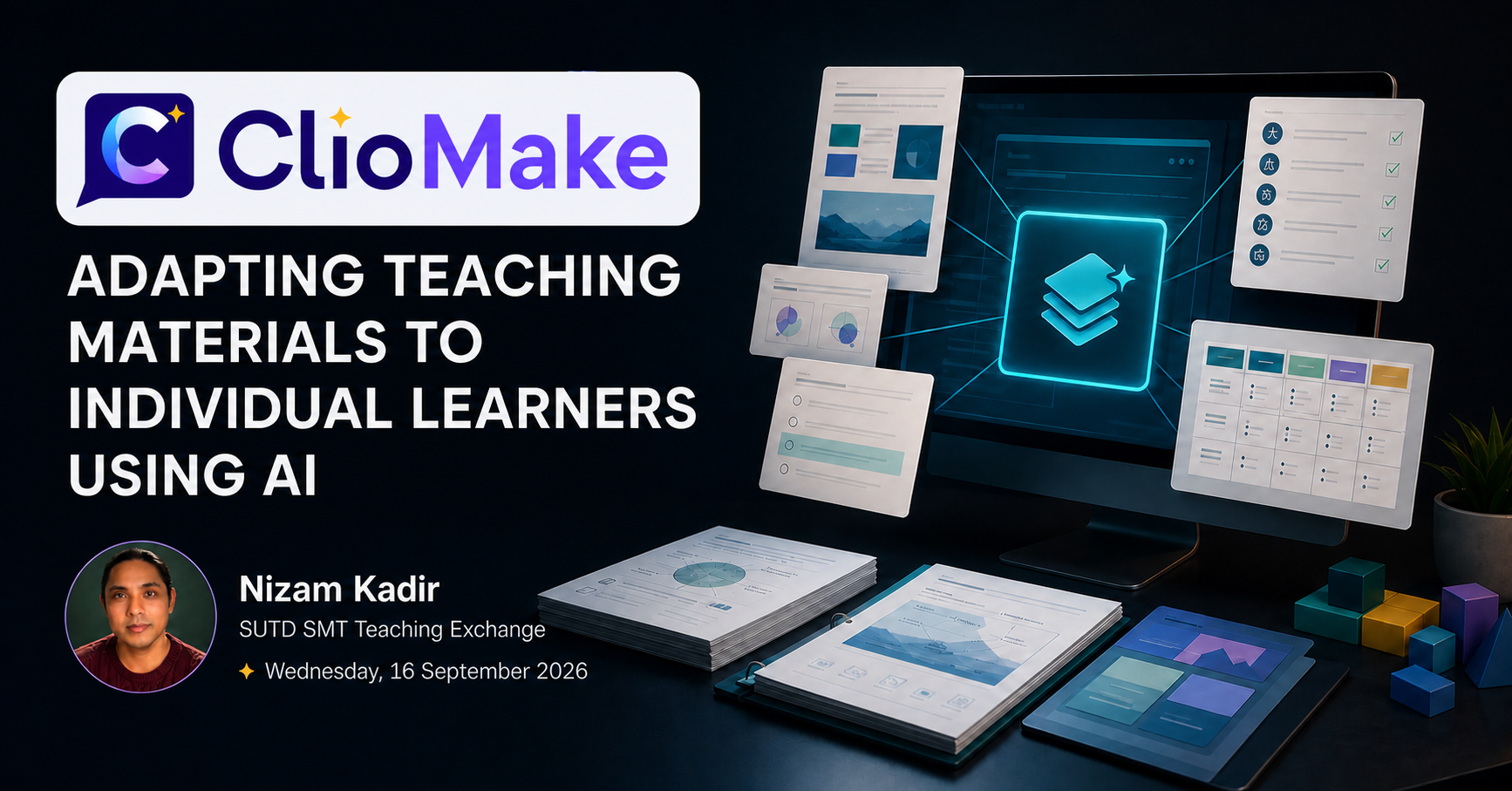
I am pleased to share that on Wednesday, 16 September 2026, I will speak at the Singapore University of Technology and Design’s Science, Mathematics and Technology (SMT) Teaching Exchange. My talk is titled “Adapting Teaching Materials to Individual Learners Using AI.”
The talk begins with a familiar classroom reality: learners arrive with different prior knowledge, levels of readiness, language proficiency and support needs. Teachers recognise these differences, but recognition does not create more hours in the week. Redesigning one lesson for several groups—and then rebuilding its worksheet, assessment, slides and follow-up activities—can quickly become a significant production burden.
That tension matters. Personalised and inclusive learning depends partly on a teacher’s ability to adjust challenge, explanation, language, scaffolding and assessment. Yet the work required to make those adjustments can limit how often they happen. The practical question is not whether every learner deserves appropriate support. It is how teachers can create that support without multiplying their workload.
Clio as a case study in AI-assisted authoring
During the talk, I will discuss Clio, an AI-powered authoring platform available at ClioMake.com. Clio is designed to help educators transform existing lesson plans, worksheets, assessments, classroom activities or a concrete teaching brief into differentiated resources for varying levels of readiness, language proficiency and learning objectives.
The ClioMake workflow treats the result as a connected, review-ready resource pack rather than a chat response. Depending on the brief, a pack can include worksheets, answer keys, quizzes, rubrics, slides, accessible HTML, QTI/LMS assessment files, editable teacher briefs, standards-planning evidence and quality evidence.
For example, an educator might begin with a single lesson activity. From the same objective, Clio can help prepare a more scaffolded version for learners who need guided steps, a language-supported version with clearer vocabulary, and an extension version for learners ready for greater challenge. The point is not to label students permanently. It is to give teachers practical options they can inspect, adapt and use as learner needs change.
This connected-pack idea is important. A block of fluent AI-generated text is not yet a usable lesson. Teachers need resources that work together: the learning objective should be visible in the activity, the assessment should measure that objective, the answer key should match the questions, and the presentation should support the same instructional sequence. Adaptation needs coherence across the learning experience.
What I will explore at the Teaching Exchange
The session will focus on several practical questions:
- How can AI reduce the repetitive production work involved in adapting the same lesson?
- How can teachers create multiple versions quickly without losing the original learning objective?
- What does meaningful differentiation look like across readiness, language and support needs?
- How can accessible and multi-format outputs support more inclusive participation?
- What must educators review before an AI-generated resource reaches learners?
The last question is central. AI can accelerate authoring, but it cannot take responsibility for a class. Educators must remain responsible for checking subject accuracy, curriculum fit, cultural and linguistic appropriateness, accessibility, assessment quality and the level of challenge. Human oversight is not a final cosmetic check; it is part of the authoring process.
A teacher-centred approach also means that AI should work from explicit educational intent. The educator defines what learners should understand, what prior knowledge can be assumed, what constraints matter and what evidence of learning will count. The system can then help generate and organise alternatives. The teacher inspects, edits, approves and, when necessary, rejects them.
From differentiated resources to learner-aware authoring
Clio’s immediate value lies in educator-directed differentiation: helping a teacher turn one brief into several coherent, usable forms. The longer-term direction is learner-aware adaptive authoring, where resource creation can respond more precisely to evidence about learner progress and need.
That future needs care. More adaptivity is not automatically better education. Learner modelling, assessment evidence and automated recommendations raise questions about validity, privacy, fairness and agency. The aim should not be to remove educators from the loop, but to give them stronger tools for seeing differences, making informed choices and providing timely support.
This talk sits at the intersection of my doctoral research in Machine Pedagogical Intelligence and my work as founder of the LearnAdapt ecosystem. Across adaptive learning, trustworthy AI, intelligent tutoring systems, learner modelling and assessment, my interest remains the same: how can intelligent systems support the work of teaching while keeping pedagogical judgement and responsibility human?
I look forward to discussing these ideas with colleagues at the SMT Teaching Exchange on 16 September. If this is a problem you recognise, explore how Clio turns one teaching brief into a connected, multi-format resource pack at ClioMake.com and inspect the public sample packs.