
Every new feature in an educational platform is also a decision about how people learn. It influences what they notice, the conversations they have and the judgements they make.
That is why I want Critsly’s development to remain closely connected to research in design education. Each plugin should address a meaningful educational need, with a clear explanation of its purpose, its evidence base and its limitations.
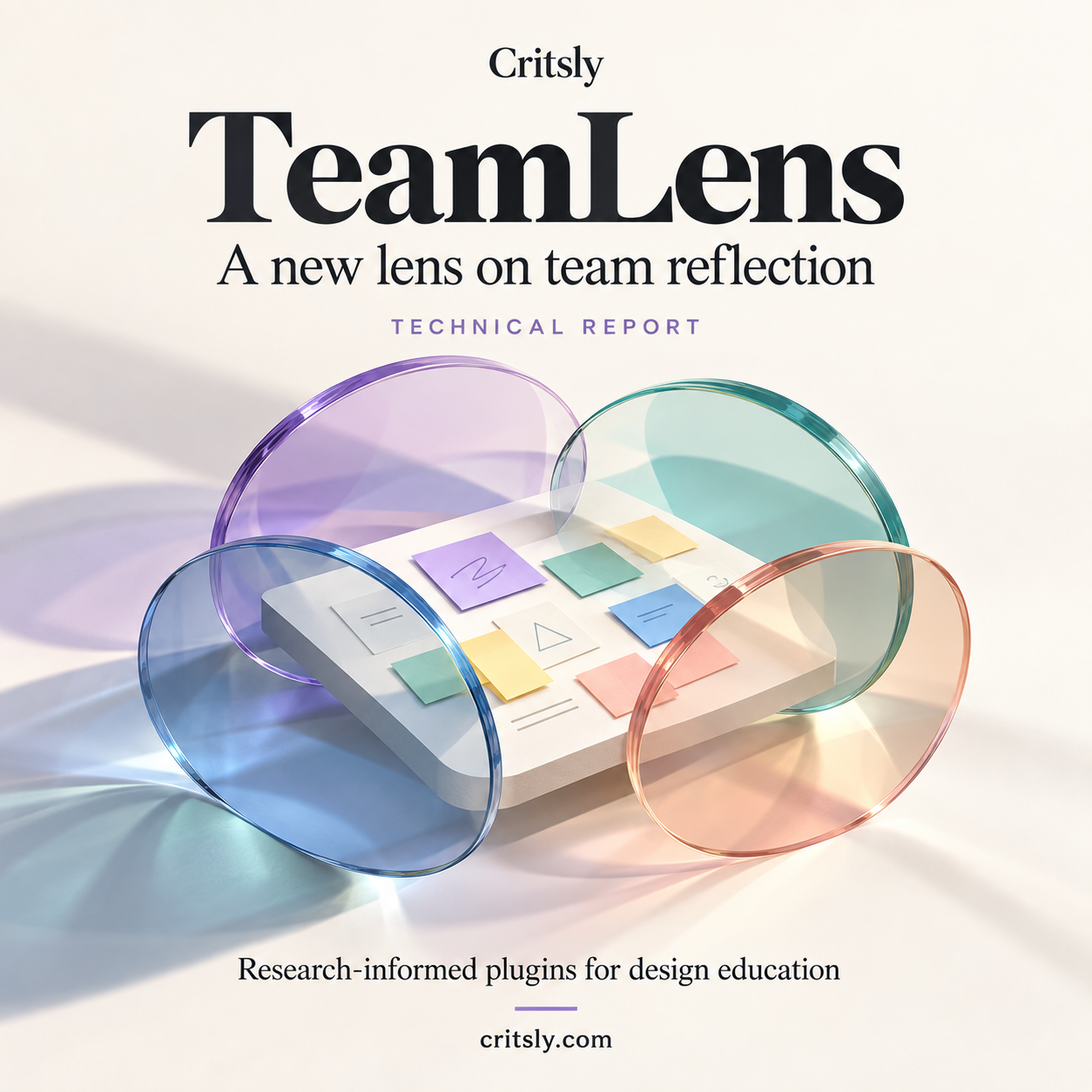
With that commitment in mind, I am pleased to share the technical report for TeamLens, a new Critsly plugin.
TeamLens introduces an optional, consent-based way for participants to share their self-reported Myers–Briggs Type Indicator (MBTI) type within a particular Critsly board. For me, it also opens a broader conversation about how we design tools that encourage reflection on working together.
Creating space for conversations about teamwork
Design education involves people making decisions together: exploring ideas, responding to critique, negotiating priorities and deciding what to develop next.
I am interested in how digital tools can help teams pause and discuss those processes. What helps each person contribute? How do team members prefer to exchange feedback? Which assumptions about one another need to be questioned?
Consider a team in which one person prefers to think through an idea before discussing it, while another develops their thinking through conversation. A useful discussion might lead them to combine individual preparation with an open group exchange.
The educational value I would look for is in that conversation and the choices that follow. A useful tool should help participants understand one another more thoughtfully while leaving room for people to surprise them.
Keeping interpretation thoughtful and participation voluntary
My position is that a self-reported personality type should be approached carefully. I would use it as an invitation to ask questions, rather than as a basis for assigning ability, responsibility or potential.
For educators considering this kind of activity, I would encourage attention to the language used around it. Asking “Does this description reflect how you prefer to work?” leaves space for disagreement and context. Assuming that a label explains a person closes that space.
TeamLens’s optional, consent-based approach matters to me for the same reason. Reflection should give participants agency over what they choose to share.
These principles also shape how I think about educational technology more generally: the tool should support thoughtful human judgement, and its design should make that responsibility clear.
What evidence-based development means for Critsly
We will be rolling out more Critsly plugins grounded in research on design education, with the aim of releasing features that are evidence-based and useful in practice.
I see that commitment as an ongoing process. It begins with understanding an educational problem and examining the relevant research. It continues through implementation, evaluation and refinement.
It also requires precision about claims. Drawing on research provides a rationale for a feature; establishing whether a particular implementation improves learning requires evaluation. I want us to make that distinction clearly as Critsly develops.
For each new plugin, the questions I want us to ask include:
– What educational need does it address?
– Which research informs its design?
– What assumptions and limitations should users understand?
– What evidence would help us assess its value in practice?
Sharing technical reports is part of making this work open to discussion. It gives educators, researchers and practitioners an opportunity to examine our decisions, challenge our assumptions and contribute to what comes next.
Help shape the next Critsly plugins
I would love to hear from people working in design education.
Perhaps there is a recurring difficulty in your studio, a gap in how students engage with feedback, or a research approach you would like to see translated into a practical tool.
If you would like us to introduce a new plugin into Critsly, please let us know. Tell us about the problem, who experiences it and what a useful improvement would look like.
TeamLens is one part of a wider direction: building a closer connection between educational research and the tools people use to learn.
Read the TeamLens technical report on SSRN: https://papers.ssrn.com/sol3/papers.cfm?abstract_id=7523918
Explore Critsly: https://critsly.com
Repository update — 2 October 2026
The TeamLens technical report is now available through both arXiv and SSRN. These are repository records for a preprint/technical report, not peer-review acceptance.
Leave a Reply