
Some honours feel meaningful not only because of what they recognise, but because of the people and community behind them. I am deeply honoured to share that I have been named a 2026 DBCS Seed Award winner.
The Seed Award is organised by Design Business Chamber Singapore (DBCS). It recognises emerging designers through five qualities that matter well beyond any single project: Creative Impact, Critical Thinking, Connective Intelligence, Perseverance, and Ethical Decision-making.
Those qualities resonate strongly with how I approach research and development in educational AI. New technology is not valuable simply because it is technically impressive. It becomes meaningful when it responds to real human needs, can withstand careful questioning, brings different people and disciplines together, persists through uncertainty, and anticipates the consequences of its use.
Gratitude for the nomination
I am sincerely grateful to Prof Lay Kee (Ricky) Ang and Dr Sumbul Khan for putting my name forward and supporting the nomination. Awards are public moments, but they are often made possible by quiet acts of support: someone notices the work, takes it seriously, and chooses to advocate for it. I do not take that confidence or generosity for granted.
I am also proud to receive this recognition as a doctoral researcher at the Singapore University of Technology and Design (SUTD). SUTD has shaped how I think about research, education and technology—not as isolated domains, but as parts of the same design challenge. Its interdisciplinary and design-led culture encourages us to move between questions and practice, and to ask not only whether an idea is novel, but whether it can become useful and responsible in the world.
Much of the work I care about sits in that space: building connections between research and application; exploring how AI can support learners and educators without displacing human judgement; and creating systems in which pedagogical decisions are interpretable, contestable and open to improvement.
That work is never done alone. It grows through conversation, critique, trust and the willingness of others to share their time and expertise. Students, educators, colleagues, mentors and collaborators have all influenced its direction. Some have contributed directly to projects; others have challenged assumptions, opened doors, or offered the kind of feedback that changes the trajectory of an idea.
Receiving the award as a seed
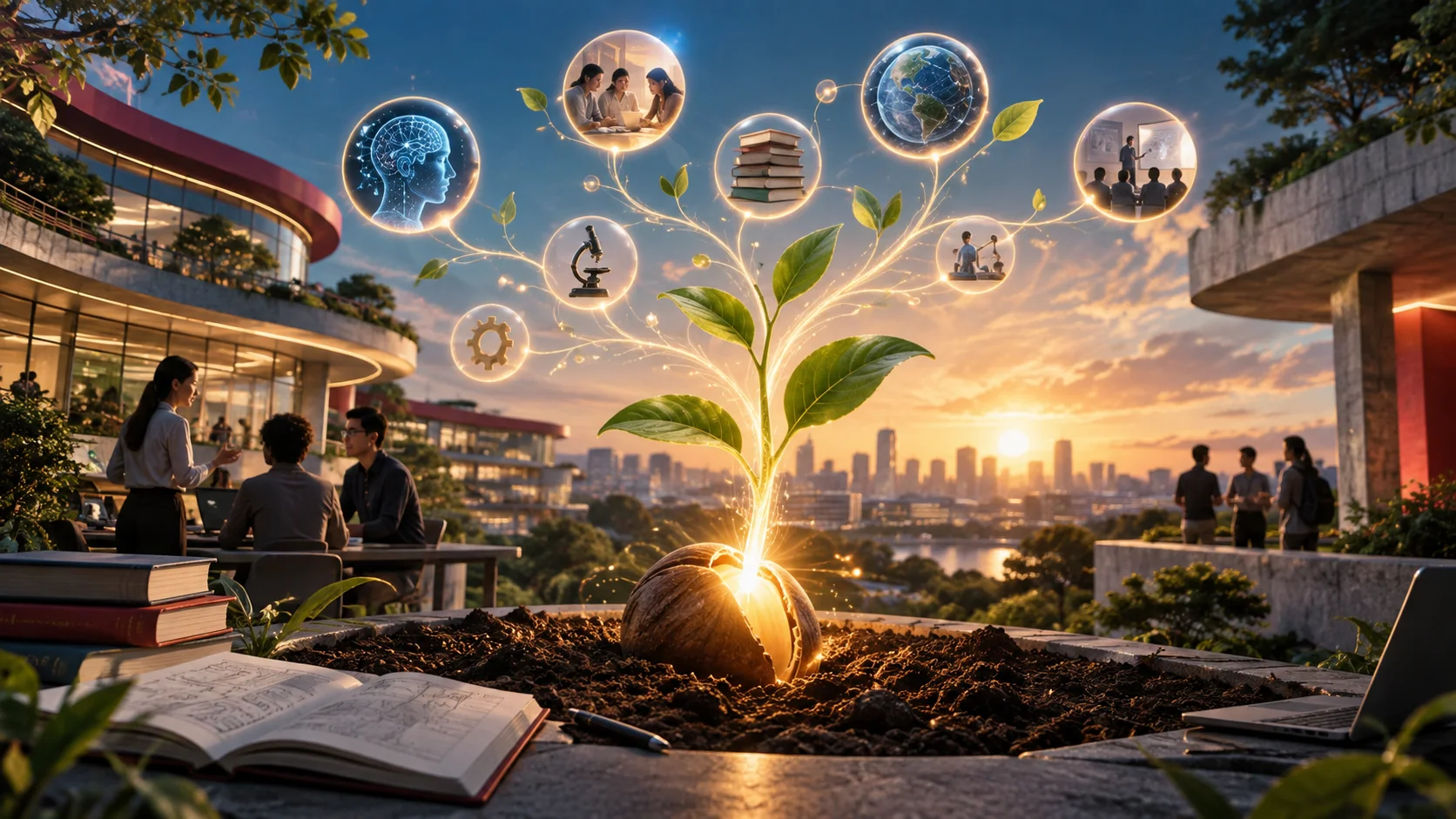
“Seed” is an apt word for how I want to receive this recognition. It is encouragement for work that still has room to grow. There are ideas to develop, evidence to gather, partnerships to deepen and outcomes that will only become possible through sustained effort.
Recognition creates momentum, but it also creates responsibility. For me, that means continuing to build educational AI around human learning rather than technological novelty; documenting both capabilities and limitations; inviting educators and learners into the design process; and making the work useful beyond a single prototype or publication.
The award’s five qualities offer a valuable compass. Creative impact asks whether the work makes a difference. Critical thinking asks whether its assumptions and alternatives have been examined. Connective intelligence asks whether it bridges people, disciplines and contexts. Perseverance acknowledges that meaningful work develops through setbacks and revision. Ethical decision-making asks who benefits, who carries risk, and how those consequences are addressed.
I will carry this recognition forward with gratitude—to Prof Ang and Dr Khan for the nomination, to DBCS for the honour, and to the SUTD community that makes ambitious, collaborative work possible.
The official list of recipients is available on the DBCS Seed Award 2026 winners page, and more information about the award’s criteria and purpose is available on the Seed Award website.
I hope this moment opens new conversations with people who care about thoughtful, human-centred innovation and who are willing to build patiently together. The seed has been recognised; the responsibility now is to keep nurturing what it can become.
Leave a Reply