
When we discuss the User Experience (UX) of emerging technologies, the conversation often circles around interface design, latency, and feature sets. However, truly transformative design requires a deeper understanding of culture. How do our cultural mental models shape our expectations of technology?
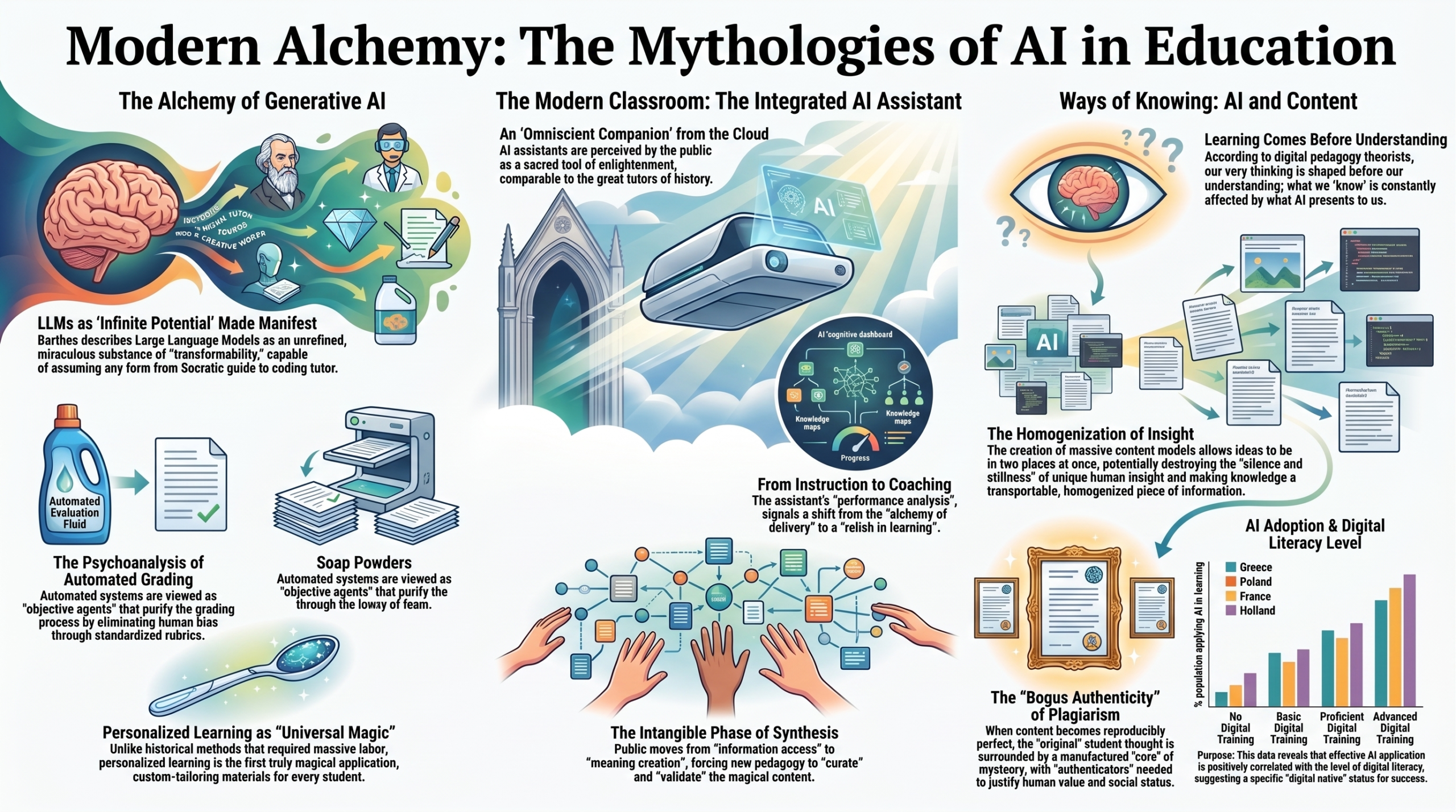
To explore this, I recently created an infographic that reimagines Roland Barthes’ seminal work, Mythologies, applying his structuralist lens to the “Modern Alchemy” of Artificial Intelligence in the classroom. Barthes examined how everyday consumer objects of the mid-20th century took on mythical, almost magical qualities in the public consciousness. Today, we see an identical phenomenon occurring with AI in education.
By replacing Barthes’ classic subjects with contemporary AI concepts, we can decode the cultural myths driving EdTech adoption—and understand why we must transition from perceiving AI as “magic” to designing it as an interpretable, orchestrated tool.
Generative AI as the New “Plastic” In his essays, Barthes described plastic as a miraculous, ubiquitous substance—less of a material and more of an idea of “infinite potential.” Today, Large Language Models (LLMs) occupy this exact cultural space. We view them as an unrefined, miraculous substance of “transformability,” capable of assuming any form we require, be it a Socratic guide, a debate sparring partner, or a coding tutor. The myth here is that the LLM is a universal solvent for educational friction, rather than a complex statistical engine that requires careful, pedagogical orchestration.
The Psychoanalysis of Automated Grading Barthes famously compared detergents and soap powders to agents of purification. In the educational realm, automated grading systems operate under a similar mythology. They are viewed as “chlorinated fluids”—objective, untamed agents that wash away human bias and purify the evaluation process through standardized rubrics. The cultural expectation is one of clinical fairness, overlooking the reality that these systems often obscure the nuanced, human elements of assessment behind an algorithmic black box.
The Integrated AI Assistant as the “Modern Cathedral” Just as Barthes likened the unveiling of the new Citroën car to the awe of a Gothic cathedral, the modern integrated AI assistant is perceived as a sacred tool of enlightenment. Operating from the cloud, it promises an omniscient companionship. This shifts the narrative of education from the “alchemy of delivery” (speed and performance) to a “relish in learning” facilitated by cognitive dashboards and personalized knowledge maps.
Ways of Knowing: “Bogus Authenticity” and Plagiarism Perhaps the most profound shift is in our relationship with content and understanding. Digital pedagogy theorists suggest that our very thinking is shaped before our understanding; what we ‘know’ is constantly affected by what AI presents to us. The homogenization of massive content models allows ideas to be in two places at once. When content becomes reproducibly perfect at scale, the “original” student thought is suddenly surrounded by a manufactured core of mystery. We are now seeing the rise of “authenticators” (like AI detectors) desperately needed to justify human value and social status in the classroom.
Moving Beyond the Magic This adaptation highlights a powerful, subtle shift: technology in the learning environment has taken on a magical quality. Unlike historical methods that required massive labor, personalized learning is being hailed as a “universal magic.”
However, as researchers and designers in Machine Pedagogical Intelligence, our responsibility is to recognize these myths and build beyond them. If we only design for the “magic” users expect, we trap educators and students in uninterpretable systems. By understanding these cultural expectations, we can consciously design AI architectures that strip away the mythological black box, replacing it with transparent, trustworthy, and human-centered pedagogical orchestration.