
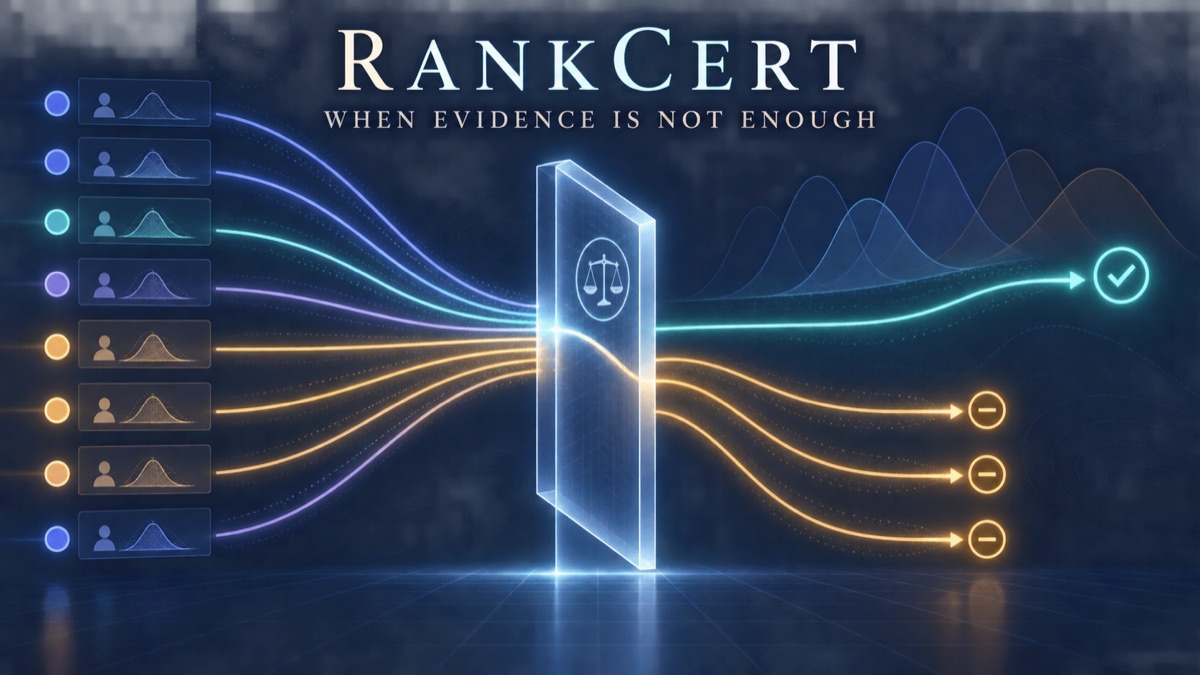
What should educational AI do when the evidence is not strong enough to choose?
Sometimes, the responsible answer is: not yet.
I am pleased to share my latest preprint, “RankCert: When Can Simulated Learners Safely Select an AI Tutor? Robust Decision Certification Under Structural Uncertainty.”
The paper addresses a narrow but consequential question in AI-supported education:
When do simulations provide enough evidence to choose one tutoring policy—and when should the system decline to choose?
Read the arXiv abstract, download the full paper, or use the permanent arXiv DOI.
The problem: predictive accuracy does not guarantee a stable decision
Simulated learners are useful for comparing tutoring strategies before testing them with people. But every simulator embodies assumptions about how learning, practice, item difficulty, history and instructional actions interact.
Two learner models can both predict observed responses adequately while recommending different tutoring policies. That distinction matters. Selecting the policy preferred by one fitted model can turn unresolved structural uncertainty into an unjustifiably definite research or product decision.
A model may predict responses well without reliably identifying which tutor policy should be preferred. RankCert was developed to make that uncertainty visible at the point of decision.
From ranking to certification
RankCert is an abstaining decision procedure. It evaluates eight equal-budget tutoring policies using several structurally different learner-model families and four neutral benchmark domains.
It certifies a policy only when the same candidate survives several complementary checks, including:
- model-averaged utility;
- probability of being best;
- posterior regret;
- consistency of rank across domains;
- coverage by multiple predictively adequate simulator families;
- leave-one-domain-out stability; and
- leave-one-visible-family-out stability.
If any required condition fails, RankCert does not substitute a fallback recommendation. It returns:
Insufficient simulation evidence to select a single tutor.
Abstention is not a missing result. It marks the boundary of what the simulation evidence supports.
A deliberately demanding benchmark
The confirmatory evaluation covered 1,280 frozen held-out settings. The design crossed five rotating held-out oracle families, 64 scenarios per family, four simulated cohort sizes (30, 60, 120 and 300), eight tutoring policies and four domains in every setting.
The scenarios represented four conditions: stable, ambiguous, structural conflict and misspecified. The learner-model families were calibrated using a licensed, de-identified derivative of EdNet-KT1 containing 5,000 learners and 590,056 retained responses. The policy-selection results themselves were evaluated in a controlled simulation benchmark. No learner received an intervention as part of this study.
What the evaluation found
Structurally different models frequently disagreed about the highest-ranked tutoring policy even though all five family representatives had passed the frozen predictive-adequacy gate. In the weakest predeclared domain, mean pairwise top-policy agreement was approximately 0.273.
Larger simulated cohorts reduced within-model cohort noise, but they did not eliminate variation between model families. More data within a simulator therefore did not, by itself, resolve structural disagreement.
RankCert was highly selective. It certified a policy in only 48 of the 1,280 settings—3.75% overall. Every certification occurred in a stable scenario. RankCert abstained in every ambiguous, misspecified and structural-conflict setting. Even within the stable stratum, it certified nothing at cohort sizes of 30 or 60; certification appeared only at the larger simulated cohort sizes of 120 and 300.
This low coverage is not presented as an unqualified advantage. It shows how rarely all the declared evidence conditions aligned. An abstention also does not mean that the policies were ineffective or equivalent. It means that the benchmark did not justify naming a single robust winner.
Lower total decision loss—but under a declared abstention cost
Under the study’s frozen decision-loss definition, abstention carried a cost of 0.01 normalized-outcome units.
At that specified cost, RankCert reduced mean held-out decision loss relative to full-coverage point selection by 0.006605 normalized-outcome units (95% CI: 0.004859 to 0.008407).
This finding depends on how abstention is valued. A secondary sensitivity analysis showed that the ordering reversed between abstention costs of 0.01 and 0.02. The result should therefore be understood as lower total benchmark decision loss under the declared cost—not as a cost-insensitive superiority claim.
An important null result
At comparable coverage, RankCert did not show a selective-risk advantage over a simpler confidence-gated point certificate.
The point-certificate-minus-RankCert selective-risk difference was −0.000213, with a 95% confidence interval from −0.003238 to 0.002384 (Holm-adjusted p = 0.929654). The interval included zero, and the comparison was not statistically supported.
This null result is a central boundary of the paper’s claim. RankCert’s supported advantage is lower total decision loss relative to full-coverage point selection under the specified abstention cost. It is not evidence of lower conditional regret than the comparable confidence-gated alternative.
What “safe” means—and does not mean
The word “safe” is used in a deliberately restricted sense. Here, it means that a policy passed a frozen, benchmark-scoped decision certificate under a declared utility and uncertainty set.
The study does not establish improved human learning, a causal treatment effect, effectiveness in a deployed tutoring system, fairness, privacy, security, accessibility or general AI safety. This is a simulation benchmark, not a human-outcomes study.
Those limitations are not side notes. They define what the evidence can and cannot support.
A connected research journey
RankCert adds a new dimension to a connected research journey.
With ES-LLMs, I explored how to separate pedagogical decision-making from language generation—making what an AI tutor decides to do explicit and auditable rather than leaving everything to a fluent response. With EduPluginBench and pedagogical release control, I investigated testable boundaries around what generated educational components may execute and what tutoring responses may disclose.
RankCert brings the next question into focus: even when a system’s decisions are interpretable and its actions are controlled, do we have sufficient evidence to prefer one tutoring strategy over another?
My broader goal is not simply to build educational AI that can do more. It is to build systems whose pedagogical choices, permissions and evidential limits can be examined.
Because being able to make a recommendation is not the same as having enough evidence to justify it.
Read and discuss
I welcome conversations with researchers working on learner simulation, AI tutoring, decision-making under model uncertainty, selective prediction and responsible evaluation in education.
Suggested citation
Kadir, Nizam. RankCert: When Can Simulated Learners Safely Select an AI Tutor? Robust Decision Certification Under Structural Uncertainty. arXiv:2609.26069, 2026. https://doi.org/10.48550/arXiv.2609.26069
Leave a Reply