
AI leaders often speak about a future of “radical abundance.” I keep returning to one question: will that abundance reach education? Athena-ES is my attempt to answer with a downloadable AI SuperTutor—not merely another subscription available to some, but learning support that far more people can possess and use.
That is the purpose of Athena-ES.
Athena-ES is my vision for a downloadable AI SuperTutor—a transparent, local learning companion designed to run without recurring AI-company subscription or API fees. I call it a SuperTutor-in-the-Pocket: an ambition to make personalised educational support less scarce and place it within reach of more learners around the world.
This is a working research prototype and a direction of travel, not a claim that the full vision has already been achieved. The aim is to build it rigorously, openly, and with collaborators who understand that educational technology must serve learners, teachers, and communities.
What is Athena-ES?
Athena-ES is a locally run, auditable AI-tutoring architecture. “Athena” represents wisdom and teaching strategy. “ES” stands for an Ensemble of Specialized LLMs.
Instead of asking one large language model to make every decision inside one opaque prompt, Athena-ES separates three responsibilities:
- Pedagogical Expert — interprets the learner state and chooses the next teaching action.
- Domain Expert — retrieves facts from educator-approved learning material.
- Communication Expert — turns the selected action and grounded facts into a learner-facing response.
The separation matters because each boundary can produce evidence: the learner state, the teaching action, the approved source, and the final response. The system is designed so that these components can be inspected, evaluated, and improved independently.
How the downloadable AI SuperTutor works
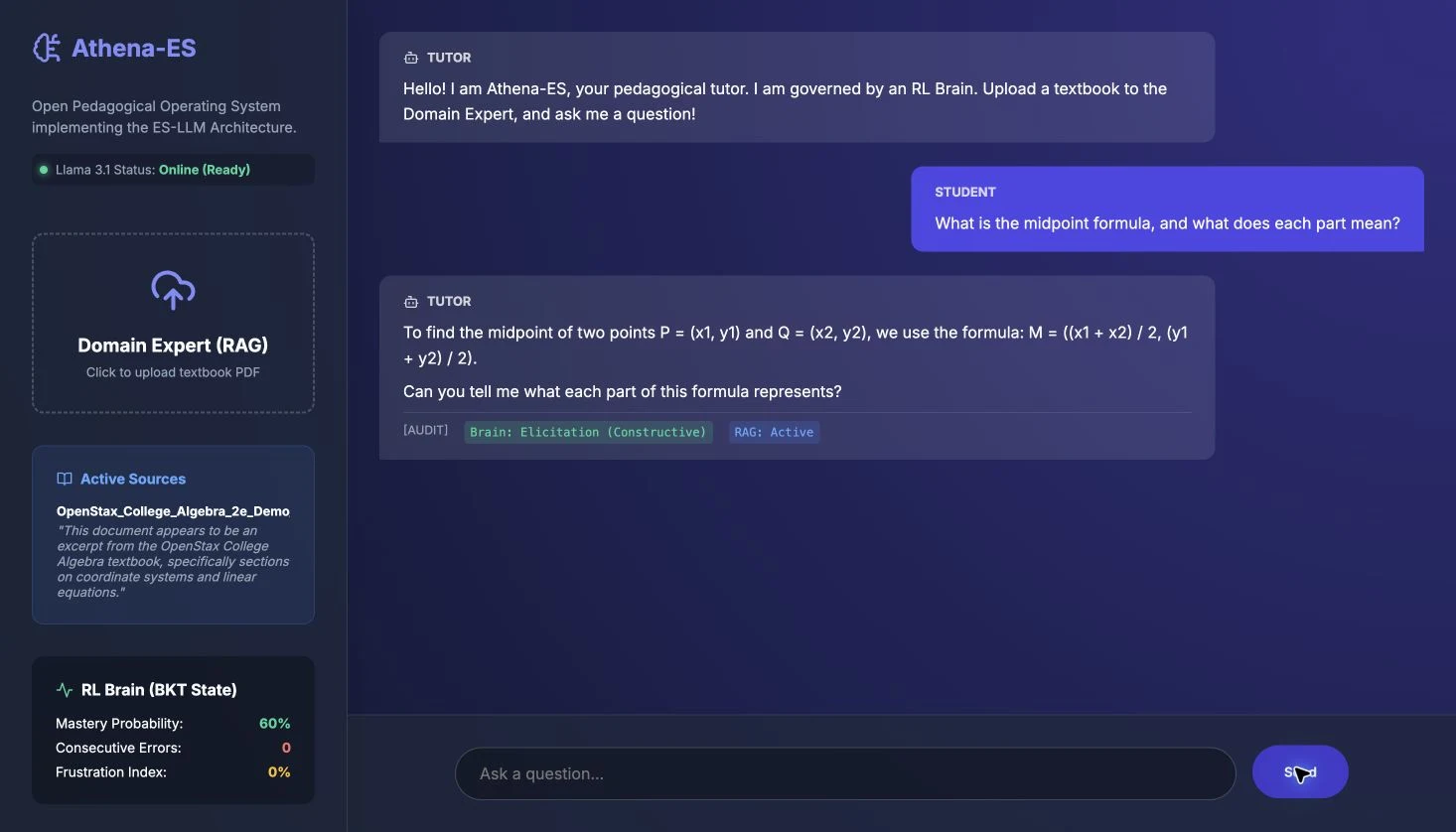
Athena-ES represents the learner using signals such as estimated mastery, consecutive errors, hints, and time spent. It then selects a discrete teaching move: elicit an answer, scaffold one small step, explain a concept, give the next procedural operation, or provide a bottom-out answer when needed.
A grounding gate checks whether the educator-approved source supports the response. If it does not, grounding can override the teaching action. This helps keep subject knowledge within a boundary chosen by the educator rather than allowing a general model to answer from an uncontrolled mixture of sources.
The screenshot above shows the local Athena-ES prototype in action using an OpenStax College Algebra source. The interface exposes the active source, learner mastery state, tutoring action, and retrieval status. These signals make it possible to see why the response changed—not only that it changed.
Auditable personalisation, not another black box
A fluent answer is not necessarily the right next move for a particular learner. Many AI tutors infer mastery implicitly and hide the reasoning behind an intervention. Strategy, content, tone, safety, and assessment can become entangled in one completion, making failures difficult to diagnose.
Athena-ES takes a function-first approach: learner state leads to a visible teaching action; the action is combined with grounded context; and a controlled renderer communicates with the learner. This connects with my broader research on Machine Pedagogical Intelligence and the pedagogical functions of intelligent systems in education.
Radical abundance must include education
The architecture is important, but it is not the purpose on its own. The purpose is educational abundance.
I want high-quality learning support to become locally available, privacy-conscious, affordable to sustain, culturally adaptable, and accessible beyond those who can pay recurring AI subscriptions. A downloadable, local system cannot remove every cost—devices, electricity, maintenance, and deployment still matter—but it can reduce dependence on metered model access and recurring provider fees.
For me, democratising education means asking whether advanced tutoring support can become infrastructure: something communities can adapt, study, evaluate, and eventually make available at far greater scale.
Why a downloadable AI SuperTutor should complement teachers
Athena-ES is not intended to replace teachers. The vision is to complement educators: to extend learning support between lessons, make tutoring decisions more inspectable, and give learners another route to timely guidance while teachers retain control over sources, pedagogy, and context.
Who should help build the downloadable AI SuperTutor?
A genuinely global educational project cannot be designed from one perspective or one place. I am looking for collaborators across the world who want to help research, build, test, evaluate, localise, and responsibly deploy Athena-ES.
I would especially welcome interest from:
- Educators, instructional designers, and learning scientists
- AI/ML, local-inference, and edge-computing engineers
- App, UX, and accessibility designers
- Researchers in assessment, safety, privacy, and responsible AI
- Multilingual and localisation specialists
- Schools, universities, NGOs, and community learning organisations
- Partners interested in learner studies, field pilots, or educational integration
Help bring Athena-ES to learners
If this mission resonates with you, please email me at nizam_kadir@mymail.sutd.edu.sg. Tell me your country, area of expertise, and how you would like to contribute—research, development, curriculum, localisation, evaluation, accessibility, integration, or field pilots.
Let us work together to turn radical abundance from an AI promise into an educational reality.